scene 1
An Empty Stadium
An empty baseball stadium is louder than a full one.
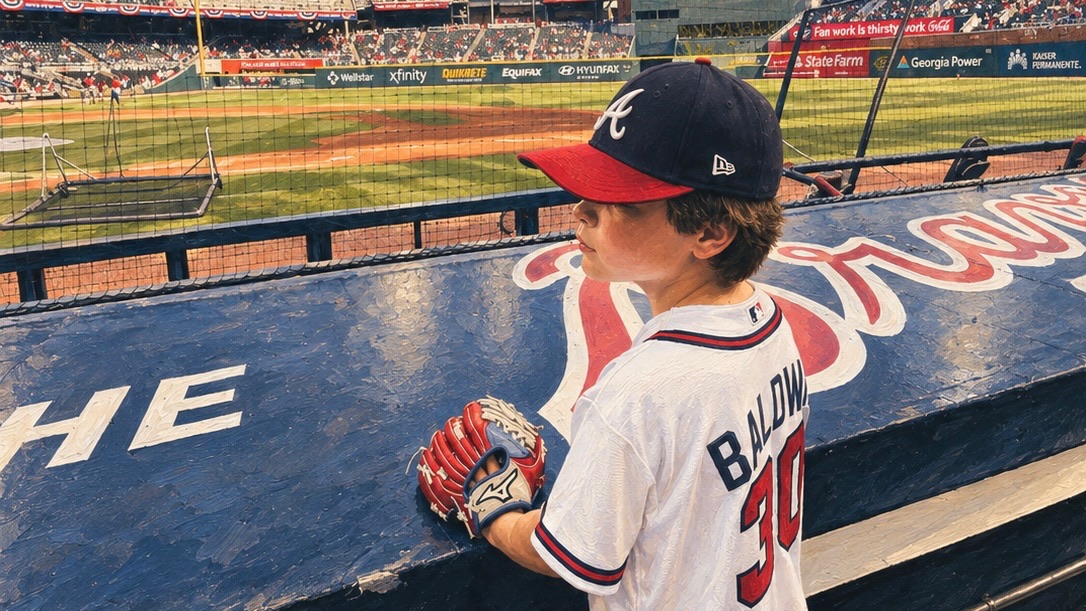
I learned this with my son Bridger on a Monday afternoon in April when the two of us and a tour guide had Truist Park almost entirely to ourselves.
Being there was something of an accident. That month the Braves were giving free stadium tours to anyone who shared a last name with a player. Drake Baldwin was a catcher. We were Baldwins, too.
A tour guide checked my ID.
Nobody else had registered, so it was just Bridger, me and our guide inside a stadium two days from its home opener.
By then Bridger knew considerably more about the Braves than most ten-year-olds and, increasingly, more than I did. He had tried organized baseball once, when he was four. His career lasted one practice before COVID shut everything down. For years afterward, baseball never called him back.
But as we moved through the stadium, he talked with our guide about players and statistics and Braves history with the easy confidence of someone who had finally discovered a subject he knew belonged to him.
The guide was impressed.
So was I.
We were walking down from the press box toward the visiting dugout when our guide stopped. A few men had appeared around home plate. One was crouched behind it, wearing white baseball pants and a blue practice shirt. There was no name on the shirt. No number.
The guide looked toward the field.
"That's Sean Murphy," he whispered.
Murphy had broken a rib during spring training. He was still on the injured list, trying to work his way back.
"I can tell just from the back," the man added.
He hesitated. Then he looked at Bridger.
"Be as quiet as you can and follow me."
We did.
He led us closer.
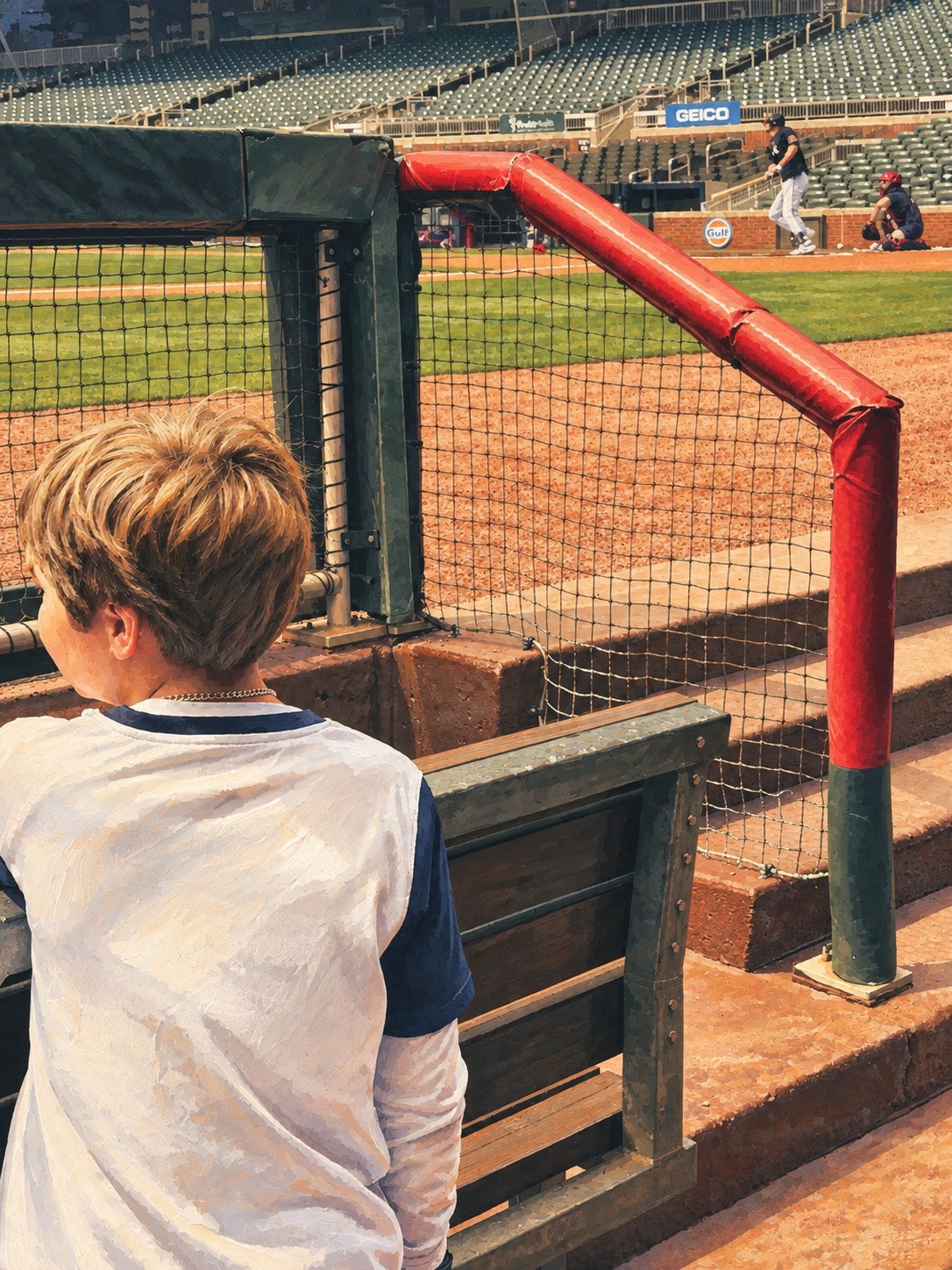
Soon we were observing from the dugout. Murphy didn't notice. Or he didn't mind.
The former All-Star caught a pitch, and the sound crossed the empty stadium. Then another. When he began to hit, the crack of the bat went out across the field and came back.
A full ballpark swallows those sounds. An empty one gives them back to you.
Bridger watched.
He didn't call Murphy's name. He didn't ask for an autograph. He didn't ask for a ball.
He bent down and put some dirt in his pocket.
Eventually we left the field and started toward the seats.
Then somebody shouted from behind us.
"Hey kid, you want a ball?"
Bridger turned.
One of the men working with Murphy threw it high over the net. We watched as it cleared our heads and landed several rows behind us.
Bridger raced up the stairs.
For a moment I lost sight of him among the seats. Then an arm appeared above them.
The ball was in his hand.
It was battered and dirty but still carried the official Major League Baseball stamp. To any reasonable person, it was a used practice ball.
Bridger wanted a display case.
Of course he did.
We bought a square plastic one from Clubhouse Store before we left. Bridger placed the ball inside the case as though we had just recovered the final out of the World Series. The dirt from his pocket eventually went in with it.
I didn't know then how many things we would carry home from baseball that year.
scene 2
Where My Father Stood
My first baseball field was not much of a field.
I was six. It sat beside a church about a mile from our house, with a chain-link backstop and an old home plate buried in the dirt. There were bases but no foul lines and no real outfield fence. In right field, trees and bushes marked home-run territory.
In left and left-center, the grass ran toward the edge of a hill and then dropped about six feet into the church parking lot below. Hit a ball far enough through the air and it disappeared. Let one roll long enough and it could disappear too.
Prickly bushes crowded the ground around either side of the backstop. Nobody wanted to go get a ball that landed in there.
I remember a group of us sitting in the shade before that first tee-ball practice, waiting for everyone else to arrive. Coach stood nearby with a clipboard, taking attendance and learning names.
He pronounced my name like "Rhine." He asked me if I could catch, then put me at first base.
This was tee ball. I don't remember much else.
I remember the field.
And I remember where my father was. He'd drive me back there to practice batting, just the two of us. When I became strong enough to clear the outfield edge in the air, I remember he pulled out his wallet and gave me a crisp $50 bill.
I think I used it to buy baseball cards. Topps, Upper Deck, and Fleer.
Before long I was playing games at Buckhead Baseball, and Dad was there for most of it. Sometimes he sat in the stands. Sometimes, when we batted, he coached first or third base. He was usually quiet until something happened—a good hit, a close play, a run—and then he would howl.
It was a sound of celebration, although an innocent bystander might reasonably have assumed he had been injured.
Before games, Dad and I listened to music in the car. One of our pump-up songs was called "AC/DC," which sounds appropriate for youth baseball if you assume I mean the Australian rock band.
I do not.
We listened to the introduction number for Electra the Electric Engine in Andrew Lloyd Webber's Starlight Express, a musical we'd seen on a family trip to London. Dad loved trains.
Apparently this prepared me for Little League.
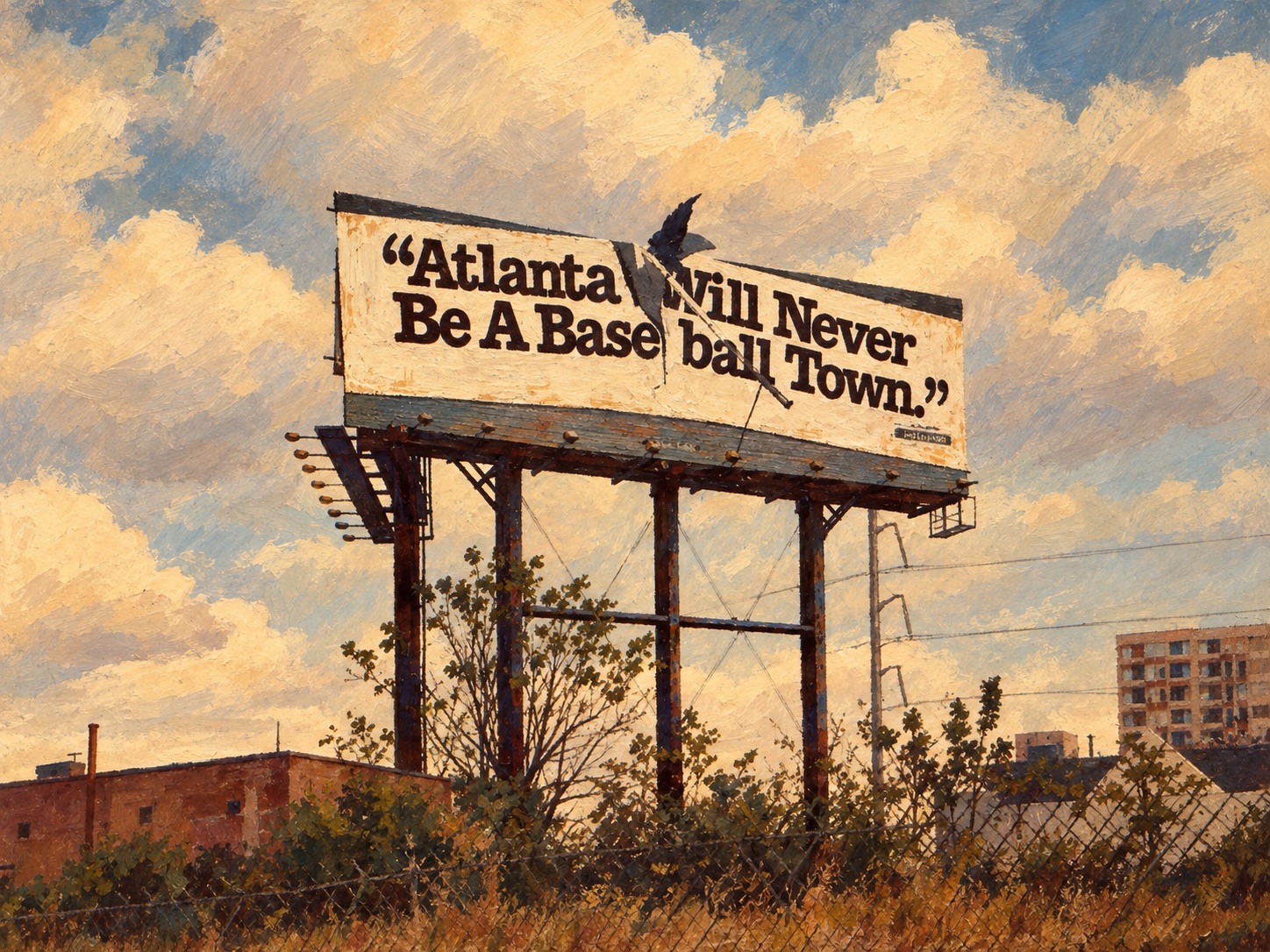
One afternoon, I remember passing a giant billboard hanging over the highway. It read, "Atlanta will never be a baseball town." The '91 Braves didn't agree. An oversized tomahawk split the lettering right down the middle.
Dad took a photo and later framed it for me.
After games, we talked about what had happened. Not every pitch. Just the parts worth remembering. A big hit I had. A play somebody made.
One or two kids could hit the ball farther than anyone else in the league. We talked about them, too.
Every so often we stopped at a gas station on the way home. I got a drink. Sometimes I got baseball cards.
Weekday practices usually belonged to Mom. She drove me there in her Buick Estate Wagon. Music was limited to two cassette tapes: The Best of Andrew Lloyd Webber and the original Broadway cast recording of Man of La Mancha.
A refrain of Don Quixote and his loyal squire Sancho replayed in my head when I took the mound.
Sometimes Mom watched practice. Other times she stayed by the car. The hood of the Buick was large enough to lay out architectural plans for the home she and Dad were building.
When practice ended, she drove me home. It was just what we did.
When I was slumping at the plate, Dad would take me to the practice fields and throw to me.
The pitches were meatballs. Down the middle. Three-quarter speed.
Our outings turned into a game of home run derby. I'd watch the ball glide into the netting above the outfield fence. Sometimes the ball would clear the net and land in someone else's outfield.
They were the kind of balls I was happy to retrieve afterward.
And I can still remember where my father stood.
scene 3
The Announcement
When we moved in the spring of 1994, baseball came home with us.
Our new house had a large backyard, and Dad continued pitching to me there for another couple of seasons. I would stand in roughly the same patch of grass where, more than thirty years later, I would throw baseballs toward my own sons.
I couldn't have known that then. I was a boy. Fathers tend to appear fully formed when you're young. They have jobs and car keys and money for baseball cards. They know where to park and what time you have to leave. They know why the runner can advance, why the umpire called him out and where the next game is.
You don't think much about where they learned any of it.
You just ask.
For a long time I thought this was where my baseball story began: a boy, his father and whatever field happened to be available.
My father has a different starting point.
According to him, baseball arrived before I did.
The Braves began the 1982 season by winning thirteen straight games. Dad remembers one of those victories especially well.
He says I was conceived afterward.
There are family stories one receives without requesting further statistical analysis.
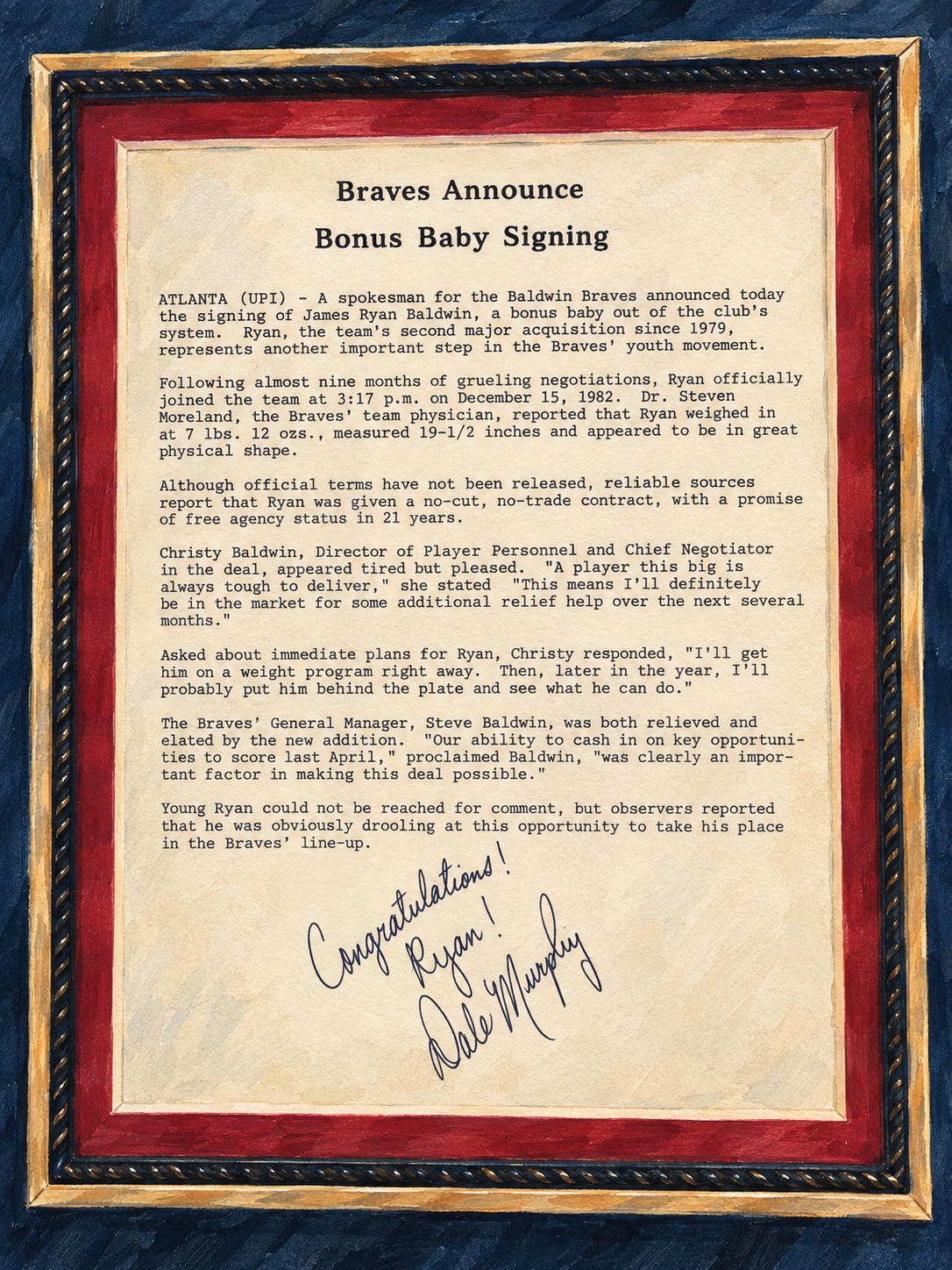
Months later, when I was born at Piedmont Hospital in Atlanta, Dad decided a conventional birth announcement would not do. He wrote mine as though the Braves had made a transaction. The organization had acquired a new player.
His name was James Ryan Baldwin.
I was days old and had already been placed on a roster.
What happened next exists in our family because my father remembers it.
He says he did not know Dale Murphy was at Piedmont Hospital. Murphy was already one of the best players in baseball. That day, he and his wife were about to give birth to a son.
According to my father's telling, Murphy saw the announcement and knocked on the door. Dad asked him to sign it. Murphy did. "Congratulations, Ryan!" he wrote above his signature.
My father kept the paper.
He had not been so lucky with everything from his own childhood. Dad collected baseball cards as a boy and still jokes that his mother threw them away—cards that, in his accounting, would surely be worth a small fortune by now.
This survived.
By the time I was playing Buckhead Baseball in the late 1980s, I understood what the signature meant. Murphy's name was on television and at the stadium and in the newspaper. He was one of the faces of the Braves.
He was not, strangely enough, my favorite player.
Children are unreliable custodians of other people's mythology.
When the Braves traded Murphy to Philadelphia in 1990, I remember being disturbed less by the mechanics of the transaction than by seeing him in the new uniform. I didn't understand contracts or aging curves or why a team might trade a player who had once seemed inseparable from it.
He was a Brave. Then he was a Phillie. How could somebody belong somewhere for so long and then belong somewhere else?
At eight, this seemed like a problem baseball should have anticipated.
The announcement stayed in the family anyway. Dad kept it after Murphy left Atlanta, after I stopped playing baseball, after I grew old enough to care about other things. Eventually he framed a copy of it with old photos of Murphy and gave the display to me. The real announcement remained folded inside my baby book, its edges aging quietly while the copy behind glass looked almost new.
I didn't know that distinction for years.
I had spent much of my life thinking my father gave me baseball because he drove me to games, coached the bases, pitched to me and made wounded-animal noises when I did something well.
But he had begun before I could participate.
Before I could throw a ball or ask a question, he had taken a game he loved and used it to explain my arrival to himself.
Then, he waited for me to learn the rules.
scene 4
Tanyard Creek Park
The last ordinary day ended with baseball.
On May 13, 2025, Hudson and I came home from his final Buckhead Baseball game of the spring. His bat and helmet and glove were still out two days later, when I left the house.
Eventually they were moved into the basement crawl space.
For sixteen days, I did not see my sons.
During those sixteen days, I went to D-Bat in Buckhead by myself.
I had splurged on a new bat after seeing Will Taylor from Baseball Bat Bros crush the ball with it. It was an Easton Hype Fire.
It hit the way I felt like hitting then.
I fed baseballs into the machine and swung until I was tired.
At one point, I walked out of the cage to talk to my attorneys about filing papers.
Then I returned to the cage and hit some more.
There are other details about those days and the end of a marriage that I am leaving outside this story.
I was doing what I could to restore ordinary time with my children. But there were long stretches when there was nothing left to do except wait.
I spent some of that waiting in places that reminded me of them.
Tanyard Creek Park was about a quarter-mile away.
I had walked there many times when we were still living together in Collier Hills. A section of the Atlanta BeltLine runs through the park, alongside the creek and beneath the trees.
During those sixteen days, I went back and walked the same route.
I could not go home. I could walk near it.
The boys didn't know I was there.
Years earlier, after we moved to the neighborhood, my father had reminded me that I had practiced baseball at Tanyard Creek when I was a boy. It was one of those facts I knew without assigning much meaning to it.
I wasn't walking there because of baseball.
I was walking a familiar path because familiar things were suddenly scarce.
Sixteen days after I last saw my sons, Tanyard Creek became the place where I would see them again.
Wrenn, their mother, chose it because it was close to the house and the boys could walk there. I arrived first and waited on a bridge over the creek.
My mother met the boys and brought them toward the park. When they were close enough, she pointed toward the bridge.
They saw me.
They ran.
"Daddy!"
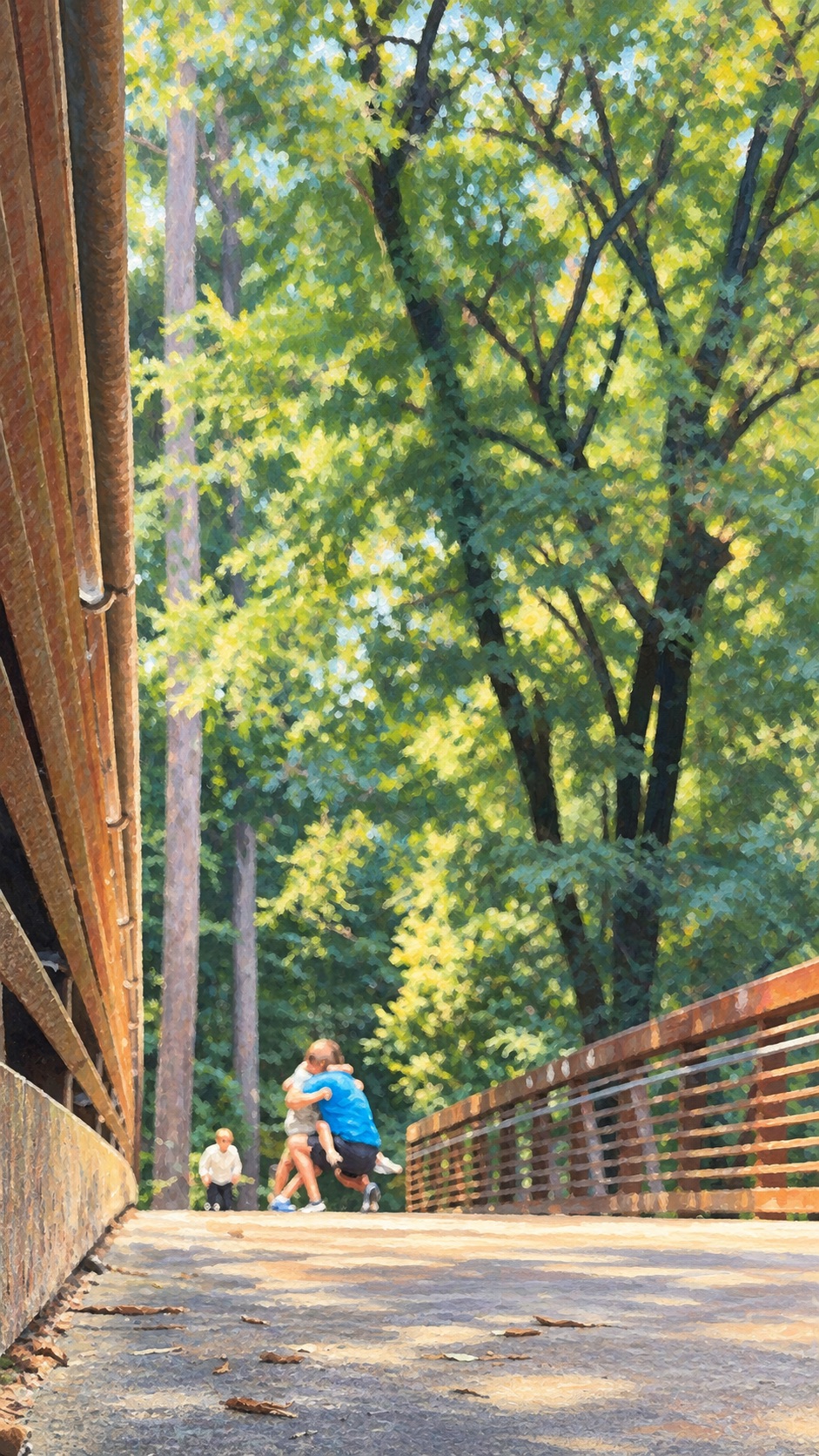
Hudson reached me first. He jumped into my arms. I held him and knelt down as Bridger reached us from the side and wrapped himself around me.
For a moment, none of us said anything.
I had set my phone up to record the reunion. I knew this was a moment I wanted to preserve and one I hoped we would never have to repeat.
The video remembers things along with me: Hudson in my arms, Bridger arriving with his yearbook in his hands, my mother standing behind them and watching the three of us on the bridge.
Bridger had brought the yearbook because he wanted to show it to me.
Sixteen days had passed. He had things to show me.
We crossed the bridge together and walked to a shady part of the field where I had spread out a blanket and laid out some new toys. I had also made us matching T-shirts.
They said BROFIST.
This requires some explanation, although perhaps not much.
The boys and I had listened to a song called "Brofist" whose catchy tune was wrapped around a considerably more serious idea: when things get hard, brothers don't give up on each other.
So I made three shirts.
We were given two hours. We opened presents. We shot off toy rockets. And we talked.
I told them I had missed them. I told them I loved them. Sometimes my voice caught when I tried to say it.
Then the time ran out.
Bridger is usually the less outwardly emotional of my two sons. When it was time to leave, there were tears in his eyes.
None of us knew when we would see one another again.
That is the part of reunion photographs they rarely show.
Everyone runs toward each other.
Eventually, somebody has to leave.
scene 5
Somewhere to Keep Meeting
An email arrived from Buckhead Baseball. Fall registration was open.
Hudson's bat, helmet and glove had spent the summer in the basement. By then I was living according to a parenting schedule, but extracurricular activities were an exception. If one of the boys had a practice or a game, I could be there.
Fall baseball meant two additional hours each week.
Two hours is not much until somebody tells you which hours belong to you.
Then it is very easy to count them.
So I registered Hudson.
On September 7, he put his baseball uniform back on for a game. It had been nearly four months since the end of his spring season. His aluminum bat, royal-blue glove, navy helmet and black cleats still fit.
Change was happening everywhere else.
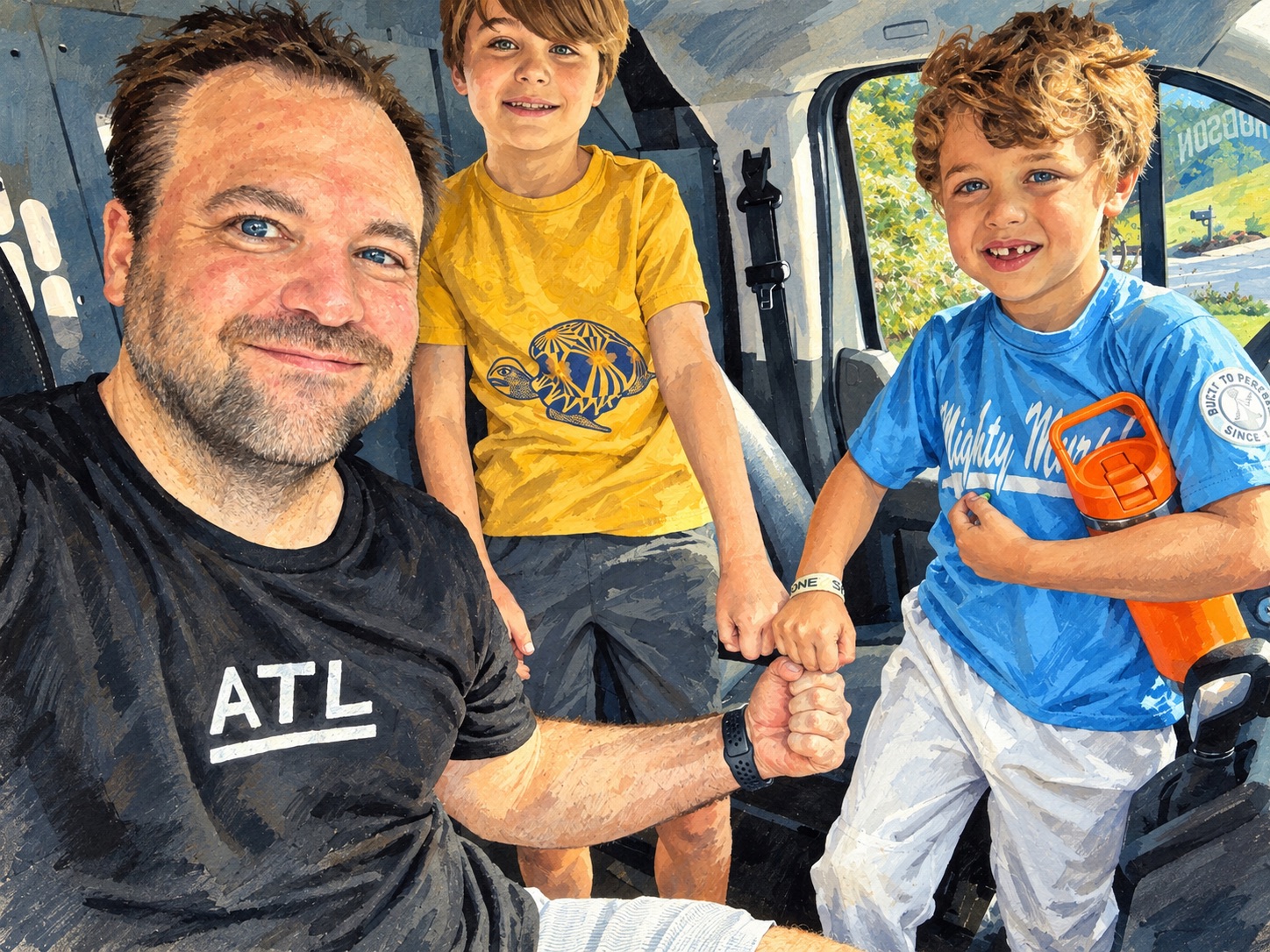
I had rented a moving truck that morning from Home Depot. Wrenn brought the boys to the house, and they helped me move my things out of the home where we had lived together.
Hudson wore white baseball pants and the shirt for his new team. The Mighty Murphs.
They were named after Dale Murphy.
By then I had learned not to make too much of baseball coincidences. There would be plenty of time for that later.
When we finished moving for the morning, the boys and I got in the car and drove to Buckhead Baseball. Hudson's bat clanged in the trunk when I turned.
I knew that sound.
I knew the drive too. I knew the fields and Coach Matt and many of the same boys from spring. I even knew the impossible parking lot, which I had cursed often enough when parking was still among the more irritating problems in my life.
It was the same parking lot where, three and a half decades earlier, my father had slept in his car overnight to make sure he would be among the first in line to sign me up for tee ball. There were only so many spots. Registration was in person then.
My father had spent a night in that parking lot trying to get me onto a baseball field.
Now I was grateful for two extra hours on one.
That afternoon, it felt good to have trouble finding a space.
I spent most practices on the field with Hudson. I hit ground balls, ran stations, tied shoes and coached whichever base needed a grown-up standing beside it. Hudson was six and easily distracted. Sometimes the most useful thing I did was remind him that a baseball game was occurring.
Hudson approached baseball with the air of a celebrity appearing in a charity softball game. His real gift was music. He could sit at a piano and work out songs by ear. His teachers were impressed.
But he could not hit a baseball out of the infield.
This didn't seem to trouble him much. I think I loved him even more for it.
Bridger found the games boring.
But he wanted to be on the field.
More precisely, he wanted to be near me.
He followed me so closely that sometimes I turned around and bumped into him. At first it annoyed me. I was trying to help with Hudson's practice, and I kept telling Bridger that this was his little brother's time.
Eventually I stopped sending him away.
So Hudson played while Bridger orbited. Wrenn sometimes sat in the stands. I stayed on the field with the boys. For a couple of hours, all four of us could occupy the same place doing something that had once been routine.
It wasn't the old routine.
It didn't need to be.
The bat still clanged in the trunk. Coach Matt was still Coach Matt. Parking was still terrible. Hudson still needed help paying attention. Children still needed their shoes tied.
Baseball had resumed without asking whether the rest of our lives were ready.
I counted practices. I counted games. I counted the extra time standing behind Hudson while he dug at the infield with his cleats and waited for something interesting to happen.
Somewhere along the way, the arithmetic became less noticeable.
By November, the boys returned to spending nights with me again. We called them overnights. Ordinary things were coming back in a different form: breakfasts and backpacks, mornings when somebody couldn't find a shoe, nights when somebody didn't want to brush his teeth.
Baseball did not put our family back together.
It gave this version of it somewhere to keep meeting.
scene 6
The Bomber Jacket
When I was eleven, my baseball coach was a former Army Green Beret and a skilled martial artist.
I was his starting pitcher.
Coach approached the game with some of the habits one might expect from that résumé. We ran laps. We did pushups. Mistakes had consequences.
We were the Orioles. He bought us beautiful jerseys and satin bomber jackets with our names on the front. He taught us the proper way to fold our pants under our socks and stirrups. It required putting our pants on backwards at first.
He didn't bring snacks after games. Instead he took us out to dinner.
He made us hit with shorter bats. There was an analogy to Barry Bonds. Maybe he was on to something. But the kids didn't like it.
And soon, their parents complained.
One day after practice, Coach asked the moms and dads to gather in the dugout. He tossed me a ball and told me to take the mound.
He reached for a 27-inch aluminum tee ball bat and stepped to the plate.
"Fastball," he told me.
I fired one down the middle.
The ping of the ball meeting the bat echoed through the trees. The ball landed somewhere out there too.
No one complained after that.
Whatever looseness I had associated with baseball—the car rides, the cards, my father howling from somewhere nearby—began to disappear beneath the feeling that I was being tested.
Sometimes the test felt personal. My arm would be gassed. We would be losing. The game might be getting away from us.
Coach left me in.
I never asked to come out.
He kept waiting to see if I would.
I never did. I'd finish the inning. I'd finish the game.
None of this made me enjoy playing for him. By then baseball had begun to feel less like a game than an endurance test.
At the end of the season, Coach called my mom. She had helped out, and he wanted to thank her.
He also wanted to tell her something about her son.
"Ryan has ice water in his veins," he said.
He told her that if he had to choose one player from the team to take to war with him, he would choose me.
I would have chosen him too.
A few years later, I learned that Coach had passed away.
I hadn't always liked playing for him. But I was grateful that I had known him.
You'd think I would have thrown away everything from that season.
I kept the jacket.
In November 2025, when the boys began spending more time with me again, I didn't have many clothes for them at my mother's house.
I went upstairs to see what was still there.
The jacket was.
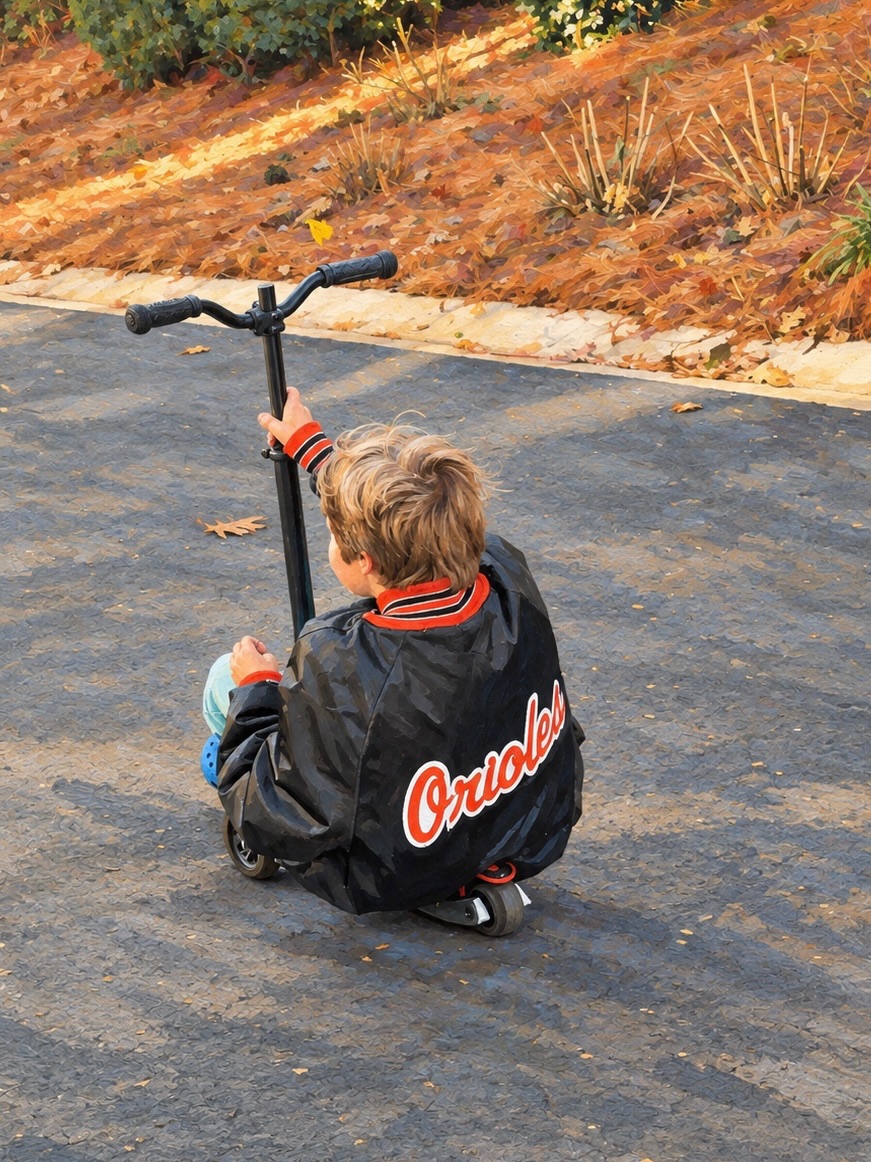
Bridger put it on.
He didn't know about the Orioles yet. He didn't know about Cal Ripken or his unbreakable playing streak.
Baseball was still months away from becoming something he wanted to understand.
He wore the jacket anyway.
ORIOLES stretched across his back.
scene 7
Hurricane
Baseball had tried Bridger before.
He was five when the Braves reached the World Series. We watched the games together when he could stay awake, which was not always.
The night the Braves won it, Bridger fell asleep before the final out.
I stayed up.
At some point I turned my phone toward myself and started recording.
Freddy Freeman caught the final out, and I looked into the camera.
"We did it," I said softly.
Bridger was asleep.
While baseball was mostly absent from our lives in 2025, another Baldwin was becoming the National League Rookie of the Year. Dad showed me the story when they announced it.
By the spring of 2026, Bridger wanted to know everything.
The change did not begin with me taking him to a game or teaching him how to keep score. It began with a bar chart.
Sometime in March, Bridger told me he had watched a Sports Stats video on YouTube showing every World Series winner in history. The teams moved across the screen as the years passed, rising and falling according to how many championships they had won.
This was his way in.
Bridger has always liked data. Once baseball presented itself as information that could be collected, sorted and compared, he began taking the game apart.
A baseball card game helped with the vocabulary: triple, double play, balk, fielder's choice. And then the questions escaped the rules.
Why did everyone know about Kirk Gibson? What made Ken Griffey Jr.'s swing so memorable? What had Hank Aaron done? Why did Jackie Robinson matter? What were the Braves before they were in Atlanta?
It reminded me of Short Circuit, a movie I loved when I was a boy. Johnny Five, a robot suddenly alive to the world, races through books and television demanding information.
"Input. Input. Input!"
Bridger was Johnny Five with a baseball reference page.
What fascinated me was the direction he traveled. He didn't become interested in the Braves and then work backward into their history. He seemed to need the history before the present could matter.
He learned that the Braves had once been in Boston and Milwaukee, that stadiums had disappeared and uniforms had changed, that generations of people had cared desperately about games that were over before he was born.
Children arrive in the middle of things and have no reason to know that they're in the middle. Parents have always been parents. Houses have always been houses. Baseball teams have always played wherever they play now.
Then somebody shows you what came before.
Bridger kept going backward until, on March 28, the present caught up with him.
I came home to my mother's house with the Braves losing late. Bridger was downstairs watching, and I joined him for the ninth inning.
Atlanta rallied.
The bases were loaded when Dom Smith came to the plate. It was his first game as a Brave. Full count, one out, tie game.
Adam Amin had the television call that night.
"Walk-off grand slam, in his Braves debut!" he said of Dom Smith.
Bridger and I jumped and hugged.
For weeks, he'd been learning other people's baseball memories. Kirk Gibson had his pinch-hit home run. Hank Aaron had 715. World Series winners moved across a bar chart, entire seasons reduced to names and years because that is what history looks like when you receive it from somebody else.
This was different.
This had happened to him.
He would never need anyone to tell him where he was when Dom Smith hit that ball. He was in his grandmother's basement with his father.
Months later, whenever a hitter reached a full count with one out and the bases loaded, he would look at me.
"You know what that's from," he'd say.
The next morning we looked up Ben Ingram's radio call and listened again. This became another habit. A game could end at night and then begin again the next morning in somebody else's voice.
Then Hurricane arrived.
Bridger had begun using my ChatGPT account to ask baseball questions, and his takeovers eventually acquired an announcement.
"Hurricane has the mic."
He asked about pitching and statistics, lineups and bullpens, players and Braves history. Sometimes I opened my account and found entire baseball conversations I had never had.
When I was his age, baseball knowledge came from my father, television announcers, newspapers and the backs of baseball cards. Bridger had artificial intelligence.
We subscribed to BravesVision and watched every game, until the game was no longer enough. We began to tune into the pre- and post-game analysis. We signed up for Lindsay Crosby's Braves Today Substack.
The games began developing margins around themselves—something to read beforehand, something to read afterward, another injury or roster move to understand before the next first pitch.
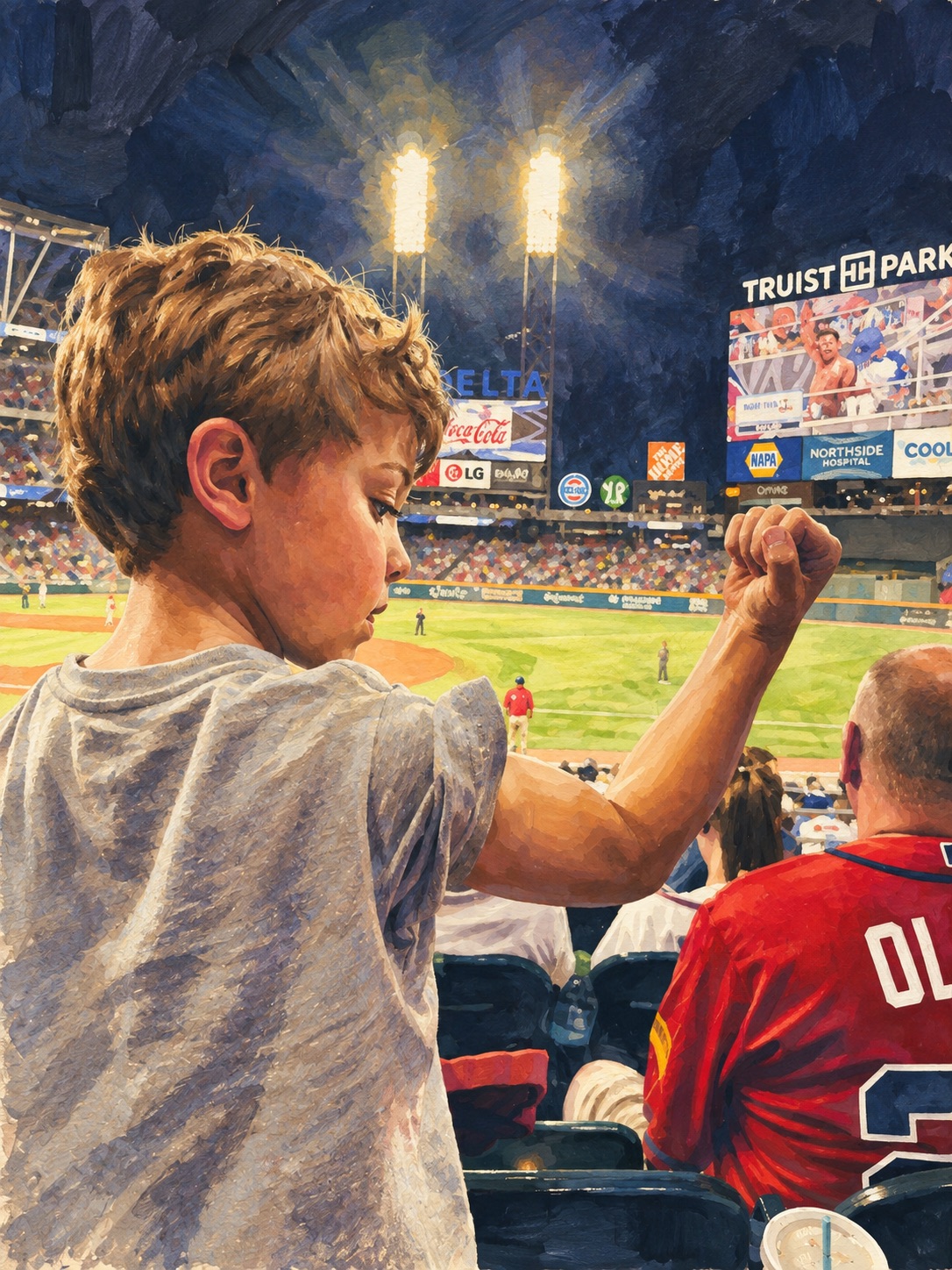
On drives to Truist Park, Bridger watched for the TKE Tower. The moment it appeared, he announced it. We were getting close.
When Bridger was with me, we watched together. When he wasn't, sometimes he called me on FaceTime during a big inning. We tried watching entire games that way at first, but our streams were rarely synchronized. One of us would pause and wait for the other to catch up, only to fall behind again. Eventually we stopped trying to defeat the internet and called during the moments that seemed likely to matter.
If the Braves had the bases loaded at my house, they had the bases loaded at his.
Whatever happened next still happened to both of us.
Bridger's new baseball consciousness followed us back to Buckhead Baseball, too. Only months earlier, he had found Hudson's games boring. Now he wanted batting averages and standings from a league whose statistical infrastructure did not meet his standards.
He privately informed me that his little brother might not be particularly good at baseball.
I replied that Hudson might be stronger than him one day.
Then Hudson put a ball in play and the analyst disappeared.
"Run! Run! Run!"
I realized that Bridger was no longer simply learning baseball. He was teaching me how much of it I had forgotten.
Somewhere in there I bought my first serious Braves jersey in decades: powder-blue, City Connect with BALDWIN across the back.
Baseball had once been one of the central languages between my father and me. Over the years, I had stopped speaking it every day.
Now my son was speaking it constantly, and I found myself answering him.
scene 8
The Backyard
My mother watches us from the back porch.
She's high enough above the yard that when she takes pictures with her iPad, we look like baseball players photographed from the upper deck.
On summer evenings, when the sun has dropped behind the trees but there is still light in the sky, I can hear her calling down to Bridger and Hudson. She has to strain her voice to make it travel across the yard, and I recognize the sound.
It is the same voice she used when I was ten, when she had to make herself heard through bleachers crowded with other parents.
There are no bleachers now, and no other parents. There is just my mother on the porch, watching her son and grandsons play on the grass below.
She has had this view for more than thirty years. The yard beneath her has changed considerably during that time. A dozen or more trees are gone, the landscape is more open, and even the grass is a different species from what grew there when I was a boy.
My mother is fastidious about her lawn, which ruins any temptation I might have to claim that the patch beneath my feet is literally the same grass where my father once pitched to me. It isn't. The old grass grew back and was replaced and grew again, as grass does when nobody asks it to carry a family's mythology.
My father would object to this distinction.
One afternoon I sent him a photograph of the boys and me playing in the yard.
"I planted every single blade of grass in that backyard," he wrote back.
There was pride in the sentence, but something else too. He hasn't lived in the house for fifteen years. My mother stayed after their marriage ended, and part of him still seems to regard the yard as something he made, something that remains his in at least one jurisdiction that memory recognizes even when the stamped paperwork does not.
In an ideal version of the scene, perhaps they would both be on the porch. My father and mother would still be married, looking down together at their son playing with their grandsons in the yard they made for us.
But that isn't the view.
My mother is there. My father receives photographs. And I am back in the house where I grew up partly because my own marriage ended too.
None of this appears to trouble my boys.
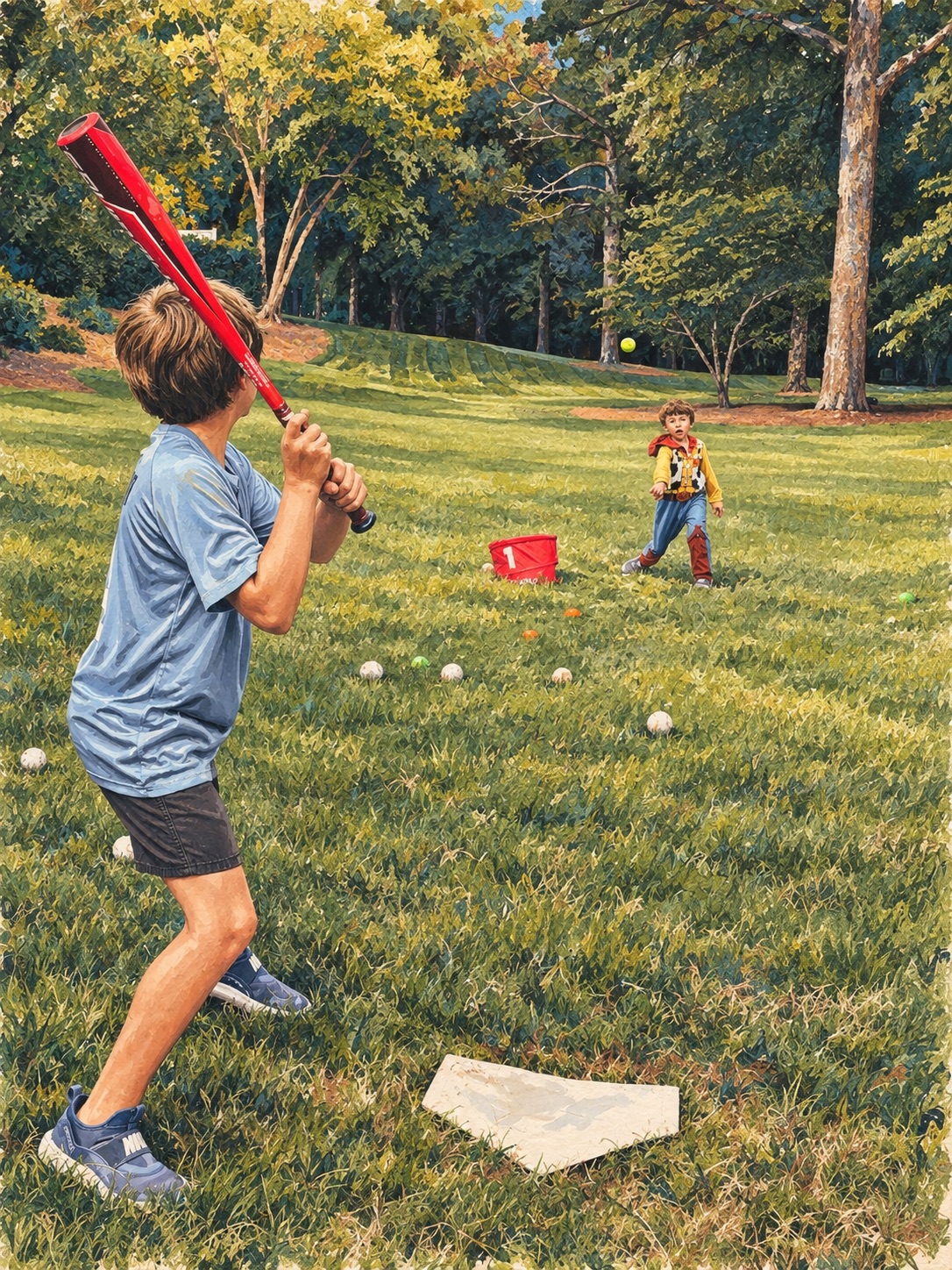
When Bridger wants to play baseball, he carries a set of portable rubber bases into the yard and begins placing them with the confidence of a groundskeeper and the spatial judgment of a drunk cartographer. His infield is badly lopsided. He does not see this. He sees first base, second base, third base and home, which is apparently sufficient evidence that a baseball diamond exists.
The pine straw and bushes along the hill become the Green Monster. A dogwood leaning toward the creek is the foul pole. There is no scoreboard because the scoreboard lives in his head, and there is an umpire there too.
Bridger calculates his batting average by counting the balls behind him against the ones scattered around the field. The math tends to favor the hitter.
Before a pitch, Bridger sometimes raises his hand behind him to ask the invisible official for time. He steps out of a batter's box that isn't there, takes a practice swing or scratches at the mosquitoes around his ankles, then steps back in when he is ready.
What interests me is where he chose to put all of this.
We never discussed the old layout. I never told him where my father had stood or where I had hit. Yet when Bridger and I began playing there, we settled on almost exactly the same patch of yard my father and I had used thirty years earlier.
I stand today where I once stood as a boy, except my role has reversed. I now pitch where I used to hit. Bridger swings from roughly the place where my father once threw to me.
If my mother looks down from the porch and remembers both versions, the players must almost fit on top of one another.
Hudson moves freely between them. He does not share Bridger's need to transform the yard into a functioning baseball universe.
Bridger wants pitches and at-bats and outs and scores; Hudson is satisfied simply to be at play. He wanders behind me, occasionally becoming an outfielder and then ceasing to be one without notifying the manager.
Some evenings he comes outside wearing Woody pajamas we bought for the first weekend of overnights in November 2025.
They hung loosely from him then.
Now they fit.
Hudson doesn't need to know that my father once pitched here or that the grass beneath his feet has changed species. He wants to roughhouse, do the moonwalk, be tossed into a swimming pool, or climb onto me when a stadium becomes too loud.
Bridger and I can spend hours looking together at the same thing. Hudson usually wants to know that the person he loves is close enough to touch.
From the porch, my mother can see both boys moving around me.
She has always liked objects and history. Her house is full of antiques and things kept long after their practical usefulness has expired. Bridger may have inherited some of his instinct for preservation from her. She photographs us from above even though we are so small in the frame that the pictures aren't particularly good portraits of anyone.
What they show better is the yard.
Sometimes I wonder what she sees when she looks through that distance. Whether she remembers my father below her or sees me as the boy she once cheered for. Whether, for a moment, the old yard lies over the new one.
I have never asked.
Maybe I am imposing all of that history on an ordinary evening she simply wants to photograph because her grandsons are outside.
Down on the grass, Bridger has taken a place altered by thirty years of weather and landscaping and family transitions and declared it suitable for baseball.
My mother calls something down from the porch. Before he can answer her, Bridger turns his back and raises one hand.
The umpire has apparently granted time.
scene 9
Two Boys, Two Games
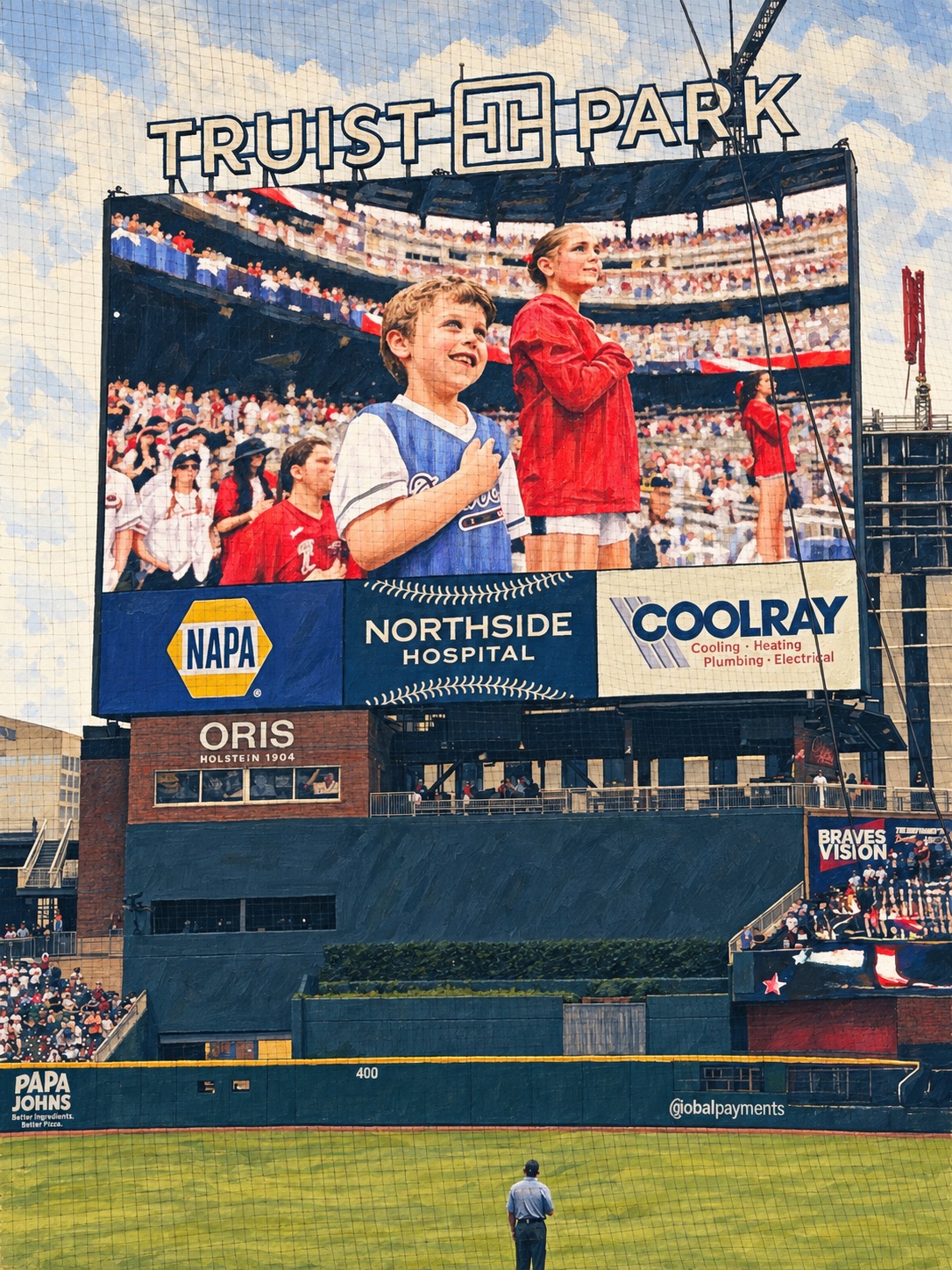
The boys had stood on top of the Braves dugout.
In the rain, they tossed Cracker Jack and T-shirts to fans. Blooper was there. The Tomahawk Team was there.
Hudson made his grand debut on the Jumbotron.
It had been quite a Seventh-Inning Stretch.
But the Braves were still losing by two to the Pirates.
When Michael Harris II came to the plate at the bottom of the inning, one of my sons was fifteen rows below me in the rain and the other was splayed across my back in a part of the stadium where the rain could no longer reach us.
Smith, Yastrzemski and Mateo had loaded the bases. From the concourse near the first-base gate, I could see parts of the field through the openings toward the seats and the rest on televisions hanging around us.
Hudson, draped in a clear plastic poncho, had asked to leave the noise and rain and go get some ice cream. Sometimes he'd park his hand inside the sleeve of my jersey, letting it hang there. Now his arms were locked around my neck, his face tucked against my shoulder.
Back in Section 120, Bridger didn't want to risk missing something important. By then he had learned that baseball was full of surprises.
The crowd had begun making that particular kind of noise a baseball crowd makes when hope starts moving faster than reason.
Bridger texted me from his watch with the flavor of freeze-dried ice cream he wanted.
Chocolate.
Then they announced pinch hitter Michael Harris. Harris had recently been injured. But the Braves needed him.
The place erupted before he ever reached the plate.
Hudson tightened around my neck. I stopped walking toward the ice cream stand and turned to watch.
I couldn't see Bridger anymore, but I knew enough about him by then to imagine what was happening below. For months he had been studying moments like this as though baseball history were a language he could make himself fluent in.
He knew what October sounded like before he had ever lived through one himself.
Now he was ten years old, standing without his father in the rain among thousands of strangers, with the bases loaded and Michael Harris walking toward home plate.
This time, not knowing what had happened, but knowing what might.
Harris swung.
I heard the crack.
The ball disappeared from view, and my eyes jumped to one of the televisions.
The crowd told us first. Hudson covered his ears.
Three runs. Braves lead.
Somewhere beneath us, Bridger disappeared into the sound.
For a few seconds the same roar was giving my sons opposite versions of the same baseball game.
I stayed where I was. Hudson had his arms around my neck and his body pressed against my back. The noise was simply too much, and he needed somewhere to put himself until it passed.
Eventually the stadium settled enough for him to lift his head.
"Are the Braves going to win?" he asked with genuine concern.
I was still excited enough that I probably answered too loudly.
"Yes! I think we are going to win! You are helping them win!"
"Good," he said, then rested his head back on my shoulder.
When I returned to our seats, Bridger was ecstatic. His cheeks had turned red. His hair was dripping wet. And he immediately declared it the greatest moment of his Braves season.
"I've never heard a crowd get that loud," he said. He says he still hasn't.
Until then, much of Bridger's baseball life had reached him through someone or something else. A card game. YouTube. Old highlights. ChatGPT. Me. He knew what great baseball moments looked like because he'd watched so many that belonged to other people.
This one belonged to him.
Nobody had needed to tell Bridger why the crowd was standing. Nobody had needed to explain what was at stake or when to cheer. He knew the game well enough now to recognize possibility before it became memory.
I had spent enormous energy that year trying to divide myself fairly between two children. Parenting time was measured on calendars and in hours. I worried about who needed me and when, about whether attention given to one boy had somehow been taken from the other.
That afternoon made the arithmetic impossible.
One son needed enough distance from me to discover the game for himself.
The other needed my back and dry ground.
Later we watched the replay of Harris standing on second base in the rain. He held his arms slightly away from his body in a confident shrug. He could have adjusted his batting gloves and looked toward the dugout.
Instead, he posed.
Baseball measures nearly everything now: exit velocity, launch angle, wind speed, win probability.
There is no statistic for knowing how to end a moment. But beneath the stadium lights and engulfed in a haze of rain, Michael Harris seemed to know.
Bridger had seen it from fifteen rows below me.
For a few minutes in the rain, I had not been there.
And he hadn't needed me to be.
scene 10
The Disease of More
After the Michael Harris game, Bridger was upset because he had nothing to take home.
This isn't what a father wants to hear at the end of a baseball game that he believes should be inherently rewarding for a child.
But for a historian like Bridger, somehow the night felt incomplete because he was leaving the game with empty hands.
I got angry.
Not very angry. I rarely raise my voice with my sons, and I wasn't interested in shaming him. But I wanted the point to land with more force than another patient explanation from Dad.
The game itself was the gift, I told him. He had been one of three children in an entire major-league stadium chosen to dance on the dugout. He had witnessed a hit he might remember for the rest of his life. We'd already been to several games that season and sat in seats most kids never get to sit in.
What else did the night owe him?
I told him about what I called the disease of more.
Adults get it too. Wanting another thing wasn't the problem. The problem was letting the next thing diminish what was already in front of us.
Bridger listened.
At a July game against the Mets, the boys and I were preparing to leave when I realized Bridger hadn't asked for anything.
At prior games, he had stopped assuming there should be something waiting for him at the end of the ninth inning. When he did want something, he sometimes began the request with a disclaimer.
"I don't want to sound ungrateful, but..."
Or:
"At the risk of sounding selfish..."
He was ten years old and already developing legal language for appealing his father's ruling.
This time, he seemed perfectly prepared to walk out of Truist Park with exactly what he had walked in with.
It was me who stopped him.
"Should we go see what they have at South End?"
His face changed. We went to look.
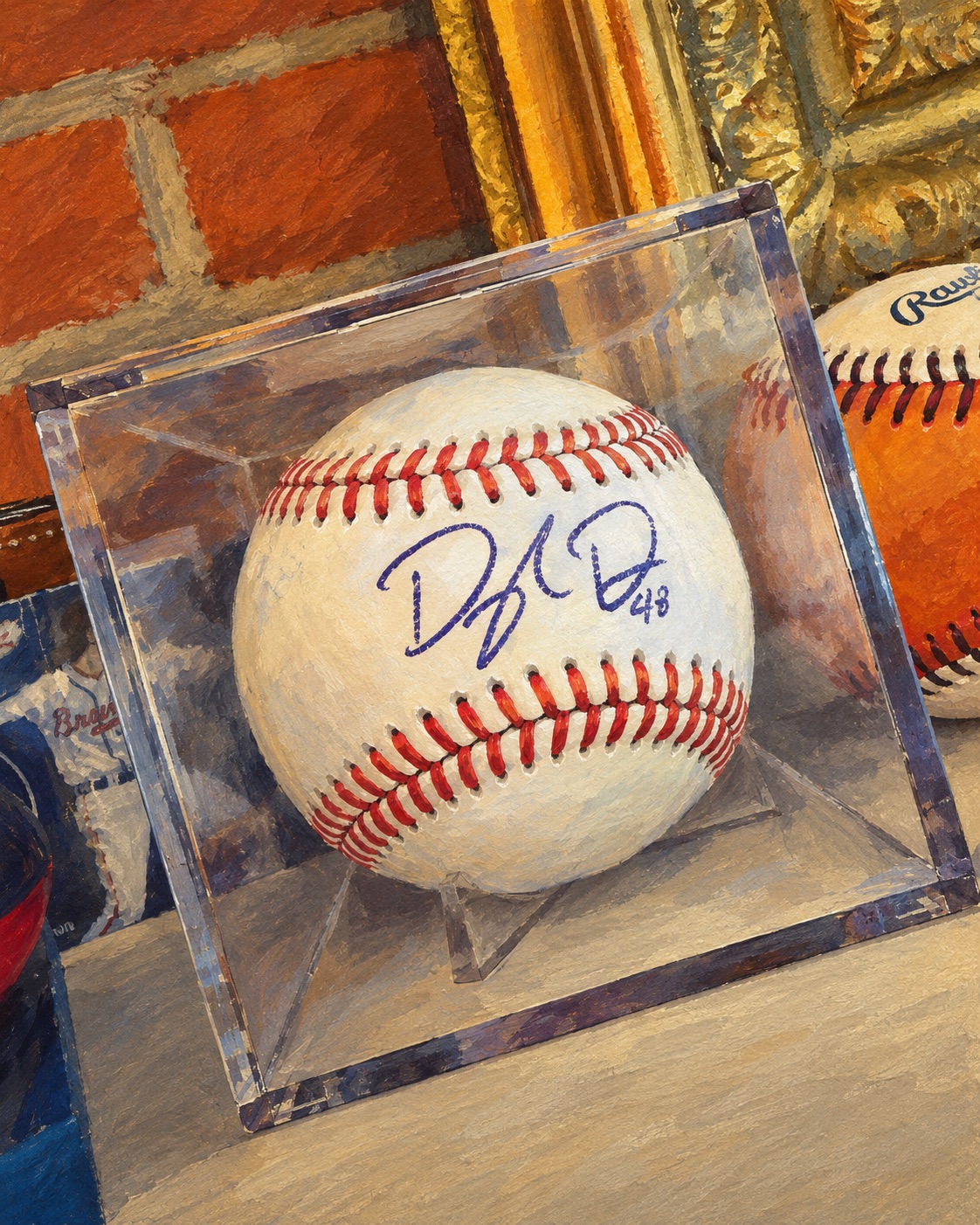
Inside the store, Bridger and Hudson each pulled one mystery ball wrapped in a brown bag out of a bin.
Months earlier, Bridger had pulled his first game-used ball from the same bin and immediately scratched off the MLB authentication sticker. He hadn't learned yet that the sticker held the key to the ball's history.
He kept the sticker on this ball. It had clearly been put in play. Maybe a single, maybe a foul. Then Bridger glanced at his brother's prize.
In his small, chocolate-stained hands, Hudson cradled a perfectly new white baseball signed by Braves pitcher Dylan Dodd.
Hudson didn't know what it was. He could tell his brother did.
So the little brother held up his hand to the big brother and offered him a trade.
At first, Bridger hesitated. Then he accepted the signed ball.
In return, he placed the game-used one in Hudson's hand.
Hudson studied it as if to verify something important.
It didn't look like a ball that belonged on a shelf.
It was one he could play with.
scene 11
Different Fathers
My father did homework before he came to the Braves game with his grandsons.
He had not followed the team particularly closely in 2026. Father's Day weekend would be his first game of the season, and Bridger had spent the spring becoming the sort of ten-year-old who could expose a gap in your knowledge before the national anthem.
Dad knew this.
So he brushed up on the Braves. It was like a language he once spoke well but had to relearn before talking with the natives.
We met at Dad's townhouse in Vinings and then drove over together. Christian came too. He is the adult son of my father's wife from a previous marriage, which made our group harder to diagram than the three-generation baseball picture I might once have imagined.
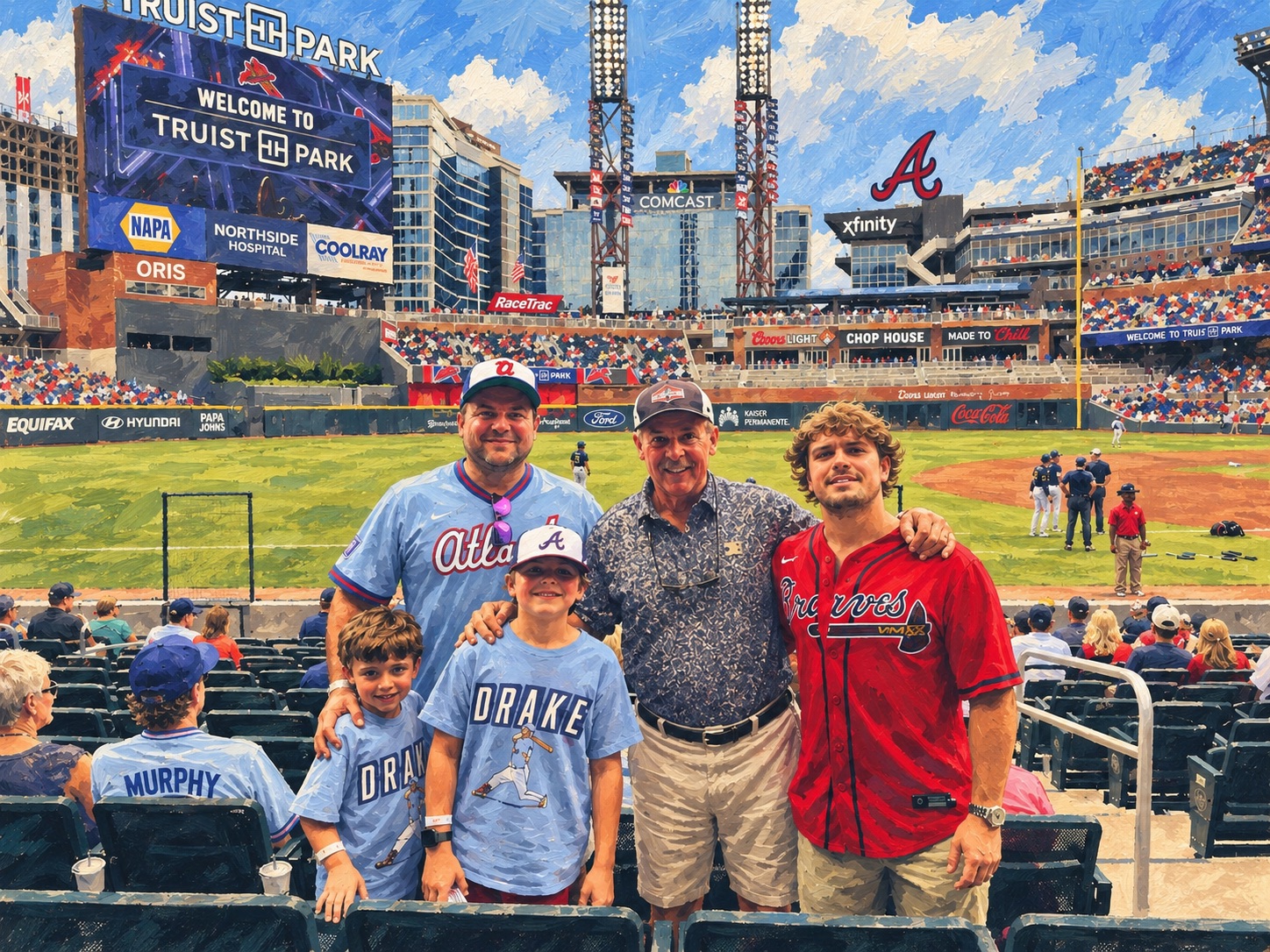
At the stadium, I bought Dad his Father's Day present between innings: a white Braves jersey with BALDWIN across the back and the number 30 beneath it, Drake Baldwin's number. Dad had suspected I might be buying one. He put it on during the game.
The jersey made the generational picture look tidier than the family actually was.
My father tries hard to connect with Bridger. Baseball gives him a way in, but the easy affection I have with my sons has never come naturally to Dad. He wasn't as physically or emotionally close to me when I was growing up as I am to Bridger and Hudson.
I don't say that as an indictment.
His own mother was not affectionate with him. His father was already in his fifties when Dad was born and passed away when Dad was still in his twenties. I never met my paternal grandfather.
By the time I became a father myself, I understood inheritance mostly as the things a parent gives a child.
I understand it differently now.
You don't transmit only what you received.
Sometimes you transmit what you wished you'd received differently.
My father gave me baseball. He slept overnight in a parking lot to get me a tee-ball spot at Buckhead Baseball. He coached the bases and pitched to me and drove me home afterward. He howled when I did something good.
I kept those things.
But with my sons, I wanted more of the physical closeness that came naturally to my mother. I wanted the roughhousing and hugs, the child climbing onto my back when a stadium became too loud, the ordinary freedom to reach for one another without thinking much about it.
Dad had given me one model of fatherhood. Mom had given me another. Neither arrived intact in my children.
That afternoon offered a small demonstration.
Hudson needed more of my attention, so Dad spent much of the game talking with Bridger. There was no ceremonial transfer of baseball knowledge. Bridger already knew the old stories—1982, my birth announcement, Dale Murphy—and none of that was particularly important to him at the moment.
He wanted to talk about the Braves who were playing that day.
So did Dad.
And because he'd done his homework, he could.
Christian sat with us too. He and my father share no blood, but blood seemed like a particularly poor way to describe the five of us that afternoon anyway. Dad's second marriage had brought Christian into his life. My marriage had given me Bridger and Hudson and then ended. Dad and Mom's had ended years before that.
The family tree was still technically a tree, I suppose, but somebody had been fairly aggressive with the pruning shears. Yet there we were.
On the drive to the stadium, we had joked about how nice it would be if the Braves gave us a walk-off for Father's Day. Late in the game, Ozzie Albies came to the plate with a chance to do exactly that.
We stood behind the visitors' dugout.
Albies swung.
The ball went out.
For a few seconds there wasn't much use distinguishing grandfather from father, son from grandson, blood relative from somebody who had entered the family by another route. There were five of us jumping and high-fiving while thousands of people around us did roughly the same thing.
My father was seventy-six.
He looked like a kid.
The next game with my boys wasn't inside Truist Park. We watched the Midsummer Classic at Cosm, where an enormous screen wrapped the field around us closely enough that, for a while, it could feel as though we were sitting inside a ballpark.
Bridger thought it was cool. But then he said he'd rather not come back.
Hudson agreed, despite having spent much of the season complaining that actual baseball games were too loud, too hot, or both.
But they were real.
I told Bridger about four All-Star games that my dad and I had traveled to in the late 1990s. Philly, Cleveland, Colorado and then Turner Field in Atlanta.
As we descended the escalators to the exit, Bridger was already talking about the 2027 All-Star Game at Wrigley Field. He paused.
"Will there be baseball next season?" he asked.
Bridger had begun following the labor negotiations along with everything else he read about baseball.
I told him about 1994.
I was eleven that summer, almost exactly his age. The season stopped in August. There were no playoffs. No World Series.
I told Bridger that a new season could be delayed. It was hard for me to imagine there would be no baseball at all in 2027.
But I couldn't promise him.
Whatever happened in the negotiations would reach people who had no seat at the table.
scene 12
Enemy Territory
Before we went to New York, Drake Baldwin sent my sons a message.
We had discovered that he had joined Cameo and was accepting video requests while he was injured. Bridger, Hudson and I wrote the request together.
We told him we were Baldwins too, that we were rooting for him while he recovered, and that we hoped he would be back with the Braves by the time we saw them play the Mets at Citi Field.
Drake's reply arrived close to midnight a few days later. The boys watched it before school that morning.
"I'm not gonna lie, I'm pretty fired up when I see some Baldwins reach out—Bridger, Hudson and Ryan," Drake said.
"Baldwins got to stick together," he added.
Bridger smiled. Then he tried not to.
This is something Bridger does when happiness threatens to become embarrassing. He presses it down until eventually there is nowhere for it to go. This time he broke into a laugh.
"Drake just sounds like such a nice guy," he said.
Then, perhaps feeling he had exposed enough of himself:
"But Drake Rakes in the batter's box," he said.
By then, the New York trip had begun to acquire the seriousness of a military campaign.
Bridger considered Mets fans the enemy.
He had once opened a pack of baseball cards and torn the Mets cards into pieces. Hudson, observing his older brother and understanding the general principle if not its finer points, began tearing up Mets cards and cards from unrelated teams too.
About twelve dollars' worth of Major League Baseball ended up in the crevices of my car.
We flew to New York at the end of July. Summer camps had finished, the boys were with me for the week, and the Braves happened to be playing in a city Bridger had always wanted to visit.
On game day, we took the Flushing-bound 7 train from Midtown. The boys wore matching powder blue T-shirts with the letters D-R-A-K-E across the front.
A Mets fan approached us on the subway.
Enemy contact.
He had been to Truist Park, he told us, and thought it might be the best baseball stadium in the country because of everything surrounding it at the Battery.
"Our stadium's nice and all," he said of Citi Field, "but surrounded by parking lots. Nothing else to do but see a game."
Then he considered what awaited us at Citi Field.
"And not a very good game if we're being honest."
So much for enemy territory.
Outside Citi Field, Bridger posed beside the Mets' Home Run Apple with his thumb pointed emphatically toward the ground. When a greeter handed him a Mr. and Mrs. Met Play-Doh set—reserved that day for children under 12—Bridger offered thanks, then recoiled.
"Daddy, I think I'm going to throw up."
He handed the box to me as though someone had asked him to dispose of something biological. Hudson then did the same.
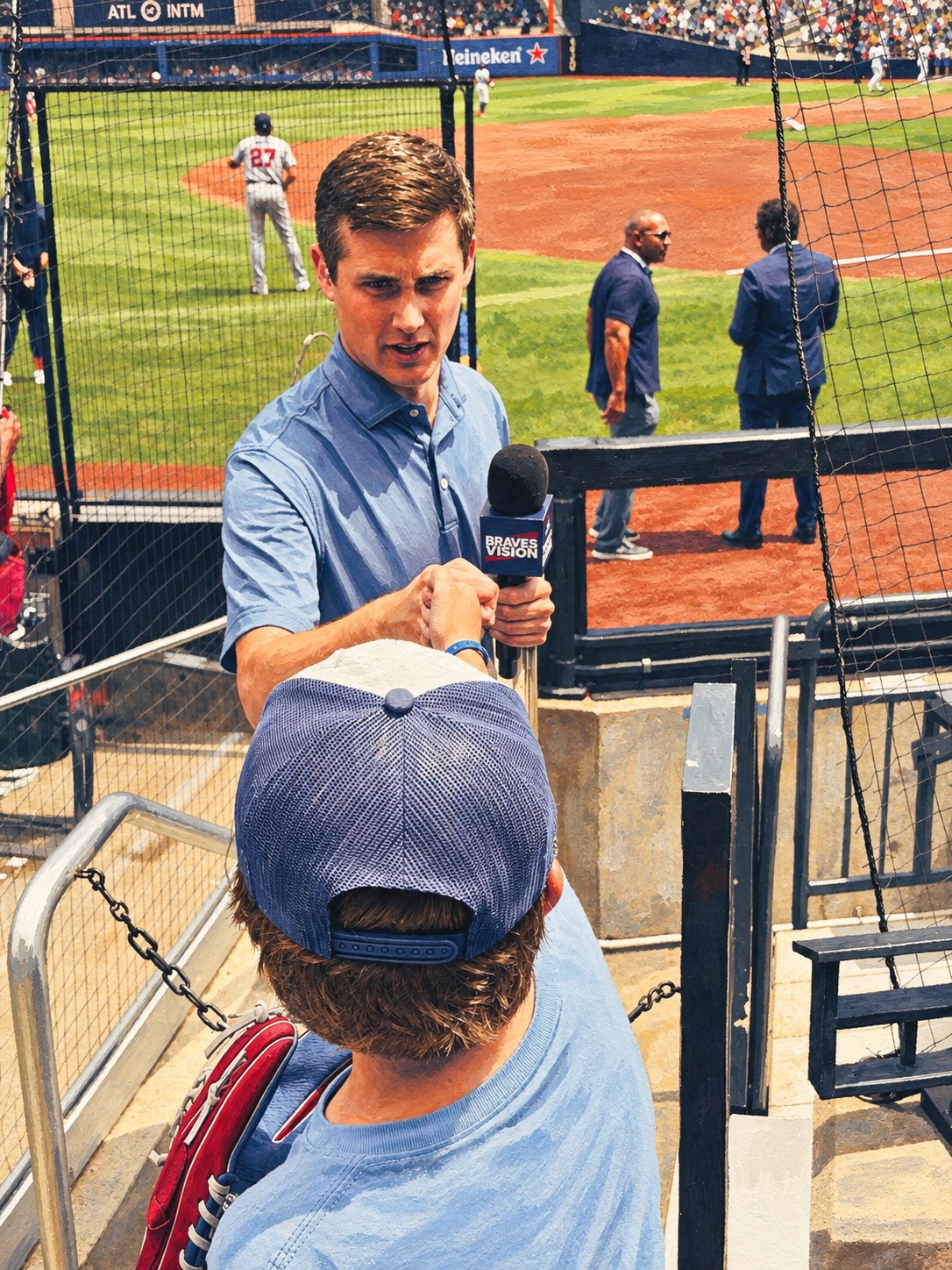
Our seats were only a few rows behind the visitors' dugout. Before the game, Bridger met BravesVision commentator Wiley Ballard, who had attended the same school Bridger now did. Wiley gave my son a fist bump.
Then, sometime around the middle of the game, Austin Riley came off the field.
Bridger had been talking about getting a ball for weeks. Hudson knew the plan too. By then, apparently, all three of us had begun treating a baseball as something that might simply arrive if we wanted it badly and positioned ourselves correctly.
Riley approached the dugout.
He looked toward us.
Then he threw.
The ball climbed high over the protective net.
I had seen this flight before.
This one was better.
Austin Riley is a Gold Glove third baseman. He had not thrown the ball vaguely toward our section.
He had thrown it to us.
I watched it float toward my hands.
I didn't need to move left. I didn't need to move right. I only had to reach up.
So I did.
Another pair of hands appeared above my head.
A man sitting one row behind us reached forward and caught the ball before it reached mine.
Then he handed it to his son.
For a moment, I felt exactly as old as Bridger.
My heart dropped.
The boy behind us was thrilled. Bridger was not.
He didn't cry. That might have passed more quickly.
Instead he folded into himself and stayed there.
The game continued. Bridger pouted. An inning passed. Then another.
The boy behind him, having noticed Bridger's disappointment, began celebrating the baseball with increasing enthusiasm.
"Wow, I love my baseball," the boy said.
Later:
"I'm so lucky I got this baseball."
I understood why Bridger was angry because I was angry too.
I had simply had more practice being disappointed.
Bridger was ten.
The Braves were not helping.
They lost 14–3.
Afterward, Bridger told me he wanted to turn around and say a few things to the boy behind him.
"That's exactly what he wants," I told him. "Don't ever give it to him."
Bridger understood.
Understanding did not improve his mood.
Hudson had mostly stayed quiet through all of this. He had expected the ball too, largely because Bridger had spent so much time explaining that one was coming.
At one point Hudson looked at me.
"Why can't we get the ball?"
It was not really a complaint. It sounded more like a question about a delivery error.
He could also see what was happening with his brother. Every so often he looked at me and smiled without saying anything, apparently aware that the wisest contribution he could make to the situation was none.
On our way out, we found Citi Field's game-used memorabilia store. There were baseballs from the game we'd just watched already for sale.
I had spent part of that summer trying to teach Bridger that a baseball game did not owe him an object at the end of it.
I believed every word of it.
Then I bought him a baseball.
There are principles, and there are subway rides back to Manhattan with an inconsolable ten-year-old.
The ball had been hit by Eli White for an infield single in the same 14–3 loss we had just endured. White would soon be traded. It was not the ball Austin Riley had thrown toward us.
But it had been on the field.
Bridger could hold it.
So we carried it out of Citi Field.
The ball helped.
A grilled chicken kebab and a Coke from a street vendor helped some more.
By evening, baseball had receded. We went to Hudson Yards and rode the elevator 100 stories to the city's highest outdoor sky deck, Edge NYC. The three of us stepped out above Manhattan as the sun was going down.
Hudson asked for popcorn. Bridger asked for nothing.
The boys were happy again.
New York spread beneath us in every direction.
Somewhere out in Queens, Austin Riley's baseball belonged to another boy.
scene 13
The Practice Ball
When August rolled around, Bridger got a taste of his first MLB trade deadline.
He took the Braves' moves harder than I expected. We watched MLB Network explain what the team had done and hadn't done, but facts weren't really what he needed.
Like so many Braves fans, Bridger had a vision for what a winning team would look like. It did not line up with what Braves GM Alex Anthopoulos had put together that day.
I reminded my son that this same executive put together a World Series-winning team in 2021. I asked him to keep the faith.
In that moment, there was nothing more I could offer him. Bridger needed to hear other disappointed people talk about it.
So I switched on Chuck & Chernoff on 680 The Fan. The hosts and callers shared his pain. It wasn't a solution, but it was something.
Thankfully, the pain didn't last.
On August 6, we were sitting behind the Braves dugout. As the game wound down, children gathered near the front and tried to get the players' attention. They called toward Ronald Acuña Jr. and the others. Hands went up. Voices got louder. Everyone hoped a baseball might come over the dugout.
Bridger hoped, too.
He tried to get noticed, but he has never been the child most comfortable making himself the center of attention. Other kids were louder, more willing to wave and shout until somebody looked their way.
The game ended without a ball coming Bridger's way. He was quiet.
A middle-aged man with a beard had been sitting in the first row. He had been loud and talkative during the game, though never obnoxious, and carried himself with the ease of someone for whom the stadium was familiar territory.
None of us knew he already had a baseball.
As the crowd began to break apart, he reached into his pocket and pulled one out.
He turned and handed it to Bridger.
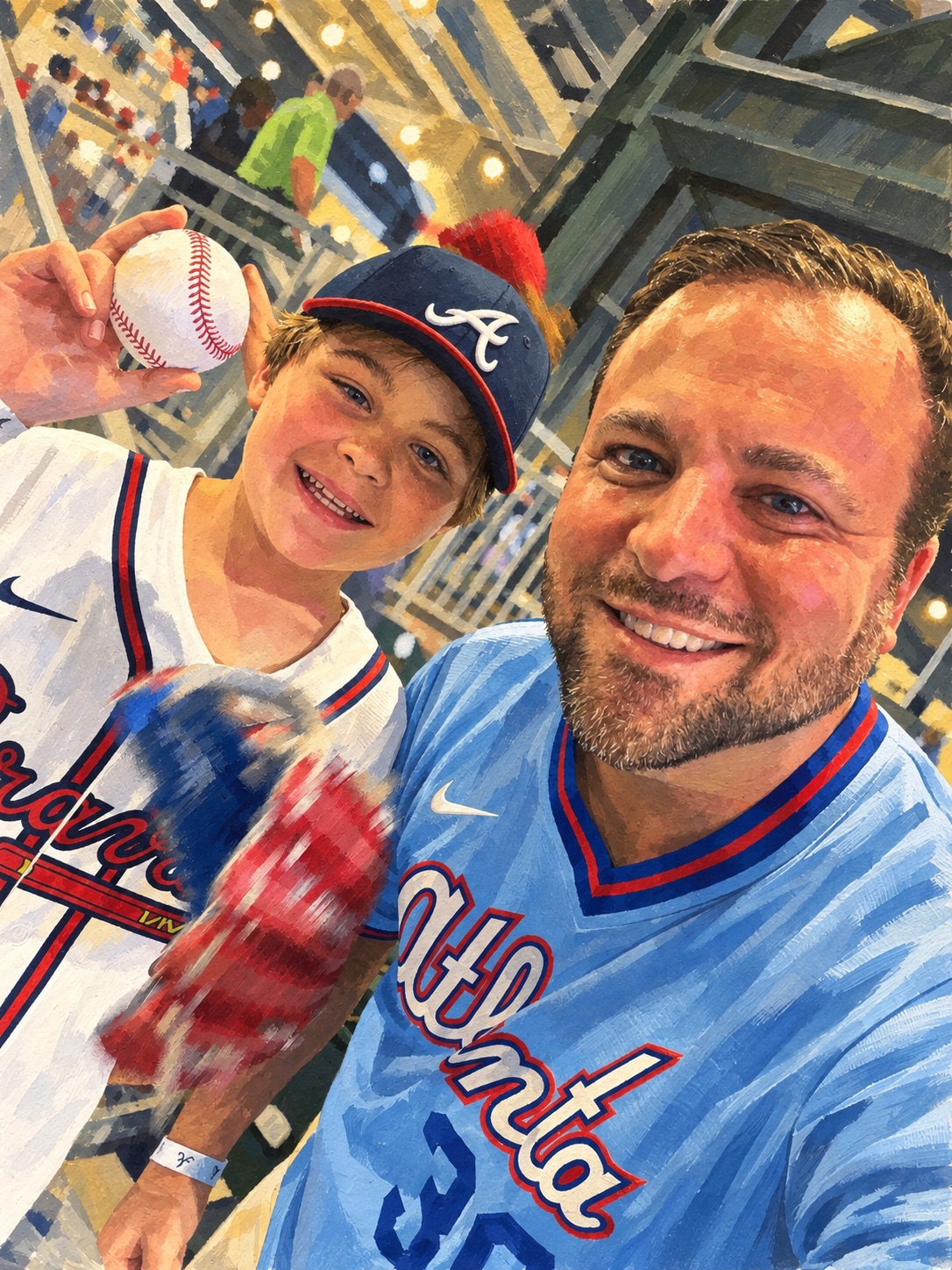
PRACTICE was stamped across it in small black letters. An official MLB ball.
"Thank you," Bridger said. It was all he could manage in that moment.
The man smiled and walked up the stairs.
That was it.
I don't know where he'd gotten the ball or how long he'd had it. I don't know why, among all the children who had spent the end of the game trying to attract the players' attention, he chose the quiet boy sitting behind him.
I can imagine explanations. None of them would be reporting.
What I know is simpler.
Another fan had watched Bridger come away without a ball. He reached into his pocket. And for whatever reason, he decided the ball he had should belong to a child instead.
Bridger carried it home.
scene 14
The Wave
Dale Murphy was still half a block away when Bridger started watching him.
We were standing along Battery Avenue outside Truist Park, across from the Coca-Cola Roxy, with thousands of other people lining both sides of the street for the Braves Alumni Weekend parade.
Bridger and I had decided to come almost at the last minute. It was another hot August day, so we let Hudson sit this one out.
A few minutes earlier, we had bought Coca-Colas from a pop-up soda fountain where they mixed them by hand in the style of 1886.
History was being reenacted everywhere that afternoon.
Old Braves rode past in convertibles and pickup trucks. Andruw Jones led the parade, newly elected to the Hall of Fame. Sid Bream passed. Mark Wohlers. Tim Hudson. Brian Snitker. Near the end came Dale Murphy, with Chipper Jones behind him.
Bridger knew exactly who Murphy was.
He knew the baseball history. He also knew ours.
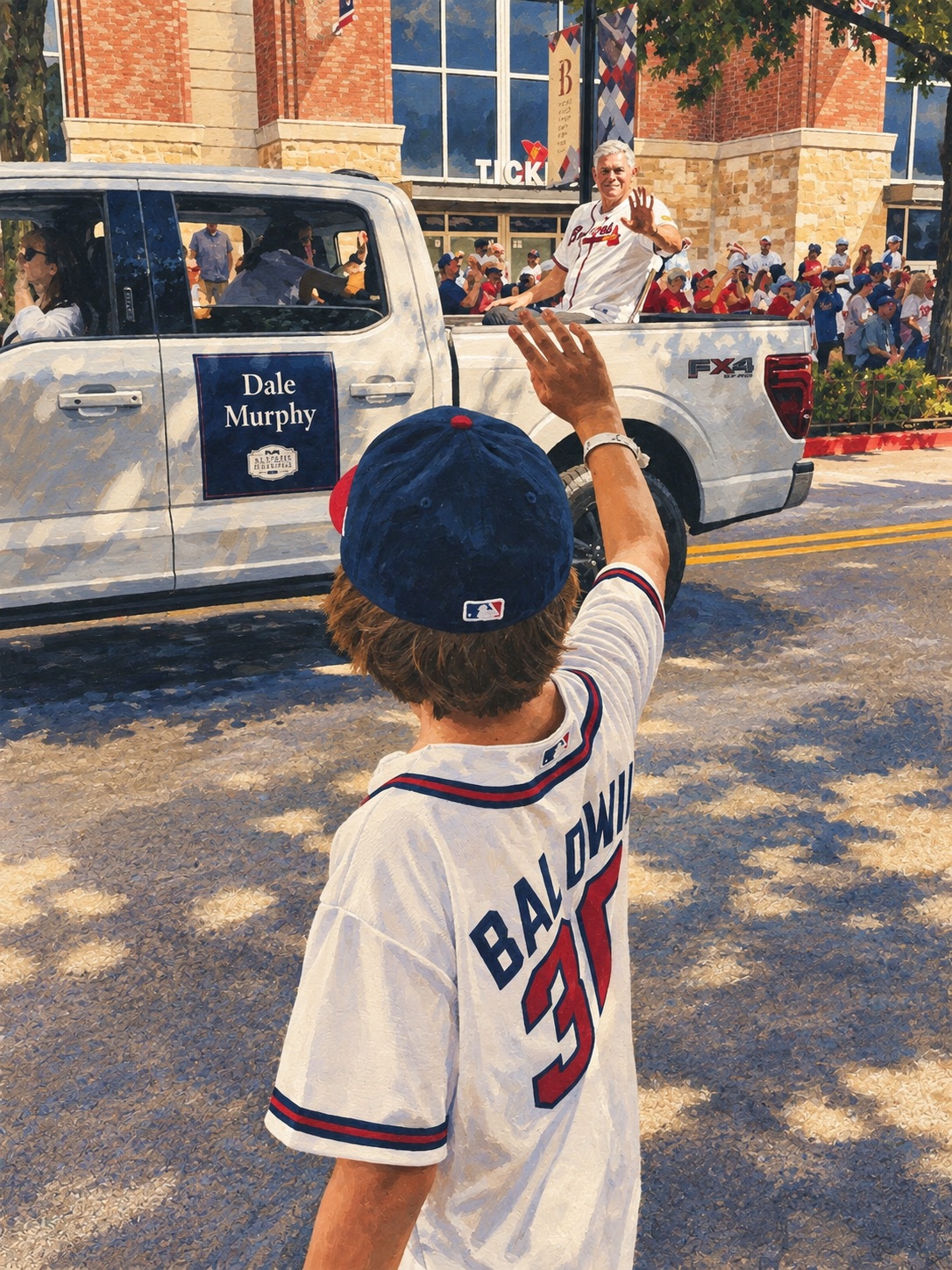
And now Dale Murphy was coming toward him in the back of a Ford F-150.
Bridger was wearing the official Braves jersey he'd wanted all season. Across his back was our last name and Drake Baldwin's number 30. Murphy was wearing the Braves jersey in which generations of Atlanta fans remembered him.
Number 3.
I noticed all of this because by then I had become susceptible to such things.
But there was no guarantee anything would happen.
Murphy sat in the back of the truck above a blue banner carrying his name. Fans waved from both sides of the street, and he waved back as the truck moved slowly toward us.
Bridger waved.
Murphy kept coming.
Bridger wasn't sure he'd seen him.
So he tried again.
He stepped a little farther into the road, separating himself from the people behind him, and raised his hand a second time.
This time Murphy looked directly at him.
And waved.
Bridger spun around toward me.
"He waved at me!"
His face had already said it.
"That was so cool. Wow."
That was all either of us managed.
I had my phone out and caught two photographs: one of Bridger waving toward Murphy and another of him turning back toward me, smiling.
Around Bridger's wrist was a silver band covered in small letter As from the game we'd been to nine days earlier.
He was still wearing it.
While trying to make a new memory, he was wearing an old one.
I sent one of the photographs to my father.
He wasn't at the parade.
A few minutes later, he replied: "If a picture ever told a story for us, that one does."
He didn't need to explain which story.
Neither, by now, does the photograph.
Murphy had once signed a piece of paper for my father after I was born. Forty-four years later, he was waving at my father's grandson.
He knew none of that.
There was no recognition in the way we understood the moment. Murphy wasn't remembering a hospital room or recognizing a family. He saw a ten-year-old boy step toward the street and wave.
So he waved back.
Everything in between belonged to us.
That was enough.
The truck kept moving.
Chipper Jones was coming next, and the crowd shifted its attention farther down Battery Ave. Parades do not stop for private family mythology.
Bridger had waved.
Murphy had waved back.
We got to hold that for a few seconds.
Then we had to let it go.
Later that month, Bridger and I found a signed Dale Murphy baseball card at Duck's Dugout in Marietta.
We bought it for Dad and gave it to him for his 77th birthday.
I learned that Dad had never told his second family the story of my birth announcement.
I asked him to.
And so he did.
scene 15
The Custodian
A man with a kind voice said my name.
I was standing with the boys inside the Braves Clubhouse Store at Truist Park.
I turned around. It was my family-law attorney. We shook hands.
For a second, seeing him there made no sense. I knew him from conference rooms and courtrooms and one of the most turbulent times of my life. His work on that chapter of our lives had been done since January.
Now, eight months later, he was standing in front of me in casual athletic clothes while Bridger and Hudson wandered through racks of Braves merchandise.
"Boys, this is Mr. Woody," I said.
Then I tried to explain who he was.
"He's the man who helped make sure we could be together again."
Bridger understood immediately.
I watched the scale of the man change in my son's eyes. All season, Bridger had been learning to recognize important people by the names and numbers across their backs. My attorney had neither. No jersey. No number.
He didn't need a uniform.
The introduction had supplied everything the uniform usually did.
My attorney extended his hand to the boys. For the first time, he was meeting the children whose return to ordinary life with their father he had helped make possible.
We talked for a few minutes. My attorney told me he had brought his elderly parents to the Battery because he thought it would be something fun for them to do together. I told him about the season the boys and I had spent following the Braves and that we were coming back for another game the next night.
"It's perfectly funny seeing you," I told him. "You have no idea."
He laughed.
Then we went our separate ways.
I returned to shopping with the boys. We picked through a few things, and eventually I saw my attorney again.
This time he was with his parents.
I walked over.
I introduced myself and told them something I thought they ought to know about their son.
I told them he had made an impact on my life. I told them he had helped reunite me with my children.
They looked surprised, then flattered, and then at their son with the particular expression of parents discovering that their child has neglected to tell them something important about himself.
Why don't you ever tell us these things?
Nobody actually said it.
Nobody needed to.
We said goodbye again.
I almost asked for a picture.
The impulse was automatic by then. We had spent much of the year keeping evidence that things had happened.
I wanted a picture of this man with the boys.
But I didn't take one.
It felt wrong.
Maybe a photograph would have made the encounter look planned. Maybe it would have reduced what this man had done for us to another souvenir from an improbable baseball season. I couldn't quite explain the resistance even to myself.
So I left my phone in my pocket.
There is no photograph of the first time Mr. Woody met my sons.
I think I'm glad.
For more than a year, I had lived inside a vocabulary of possession and permission: custody, parenting time, access, overnights, fifty-fifty. The words were necessary. They determined where children slept and when a parent could see them.
But the relationship itself was never something a court, a lawyer, or either parent could own.
By summer, the boys were spending alternating weeks with each parent.
On my weeks, baseball had room to become something larger than the two-hour exceptions I once counted so carefully. We could decide on a game and go. We could stay home and watch one.
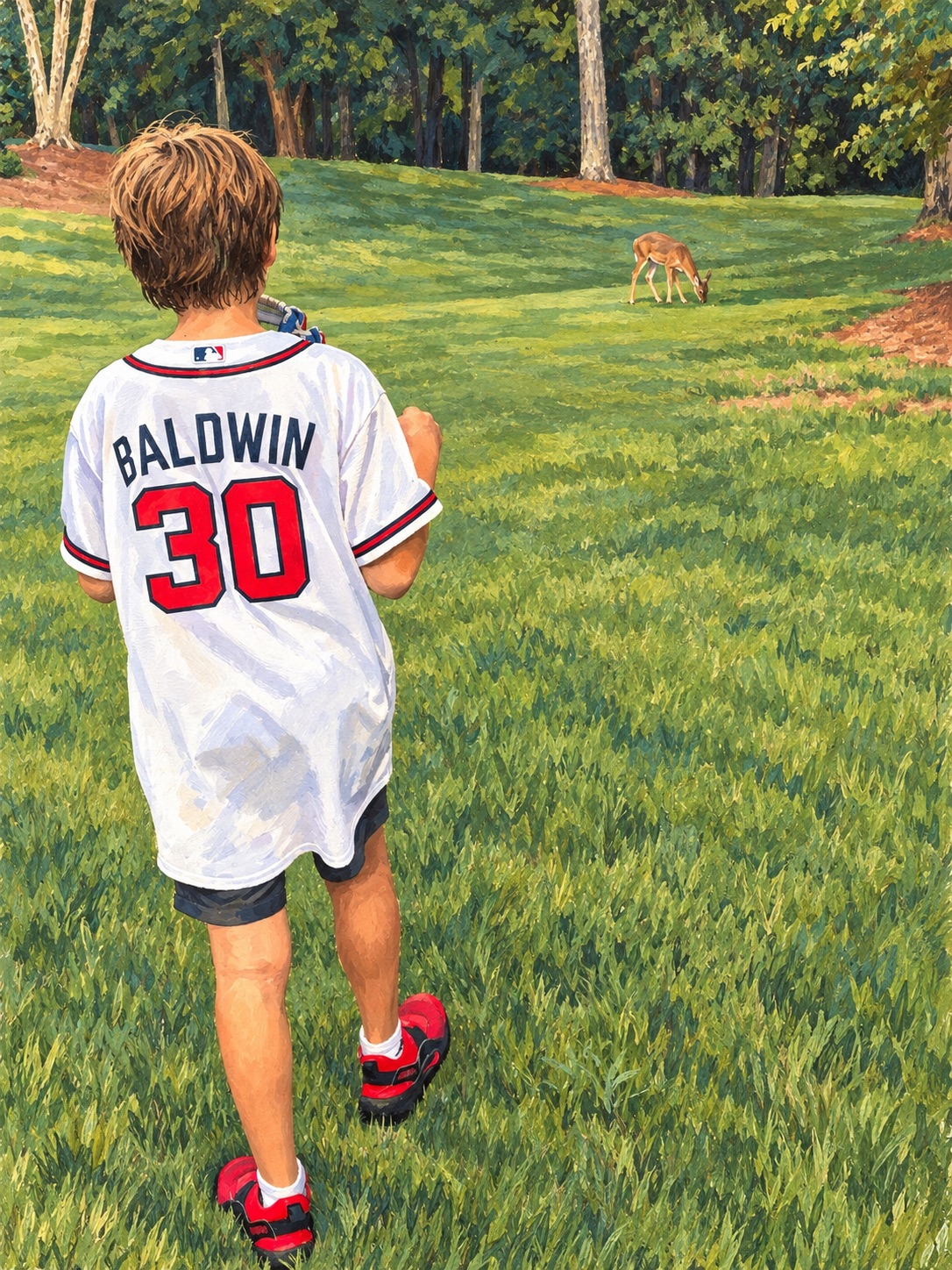
We could play in the backyard until the light disappeared behind the trees and the deer emerged from the brush to feed and spectate.
Much remained unresolved, but the boys knew where they would be.
They knew where they belonged.
What stayed with me was the distinction I had been forced to learn: control is real, but control is not ownership.
scene 16
Drake Rakes
Bridger's first season as a diehard Braves fan was moving toward its end.
Atlanta was fighting Philadelphia for the division, and every night he watched the standings as if history were being written specifically to prevent him from sleeping.
On September 11, the Braves hosted the Phillies at home. It was after eleven when Drake Baldwin came to the plate in the bottom of the eleventh.
Bridger was at one house and I was at another. Hudson was already asleep.
Bridger and I stayed up together anyway, connected by FaceTime and two television broadcasts that refused to stay synchronized. After each commercial break, one of us paused until the other caught up.
Five years earlier, Bridger had slept through the end of a World Series.
This time he was still awake.
Together, we watched Drake Baldwin drive the ball into the gap and win the game.
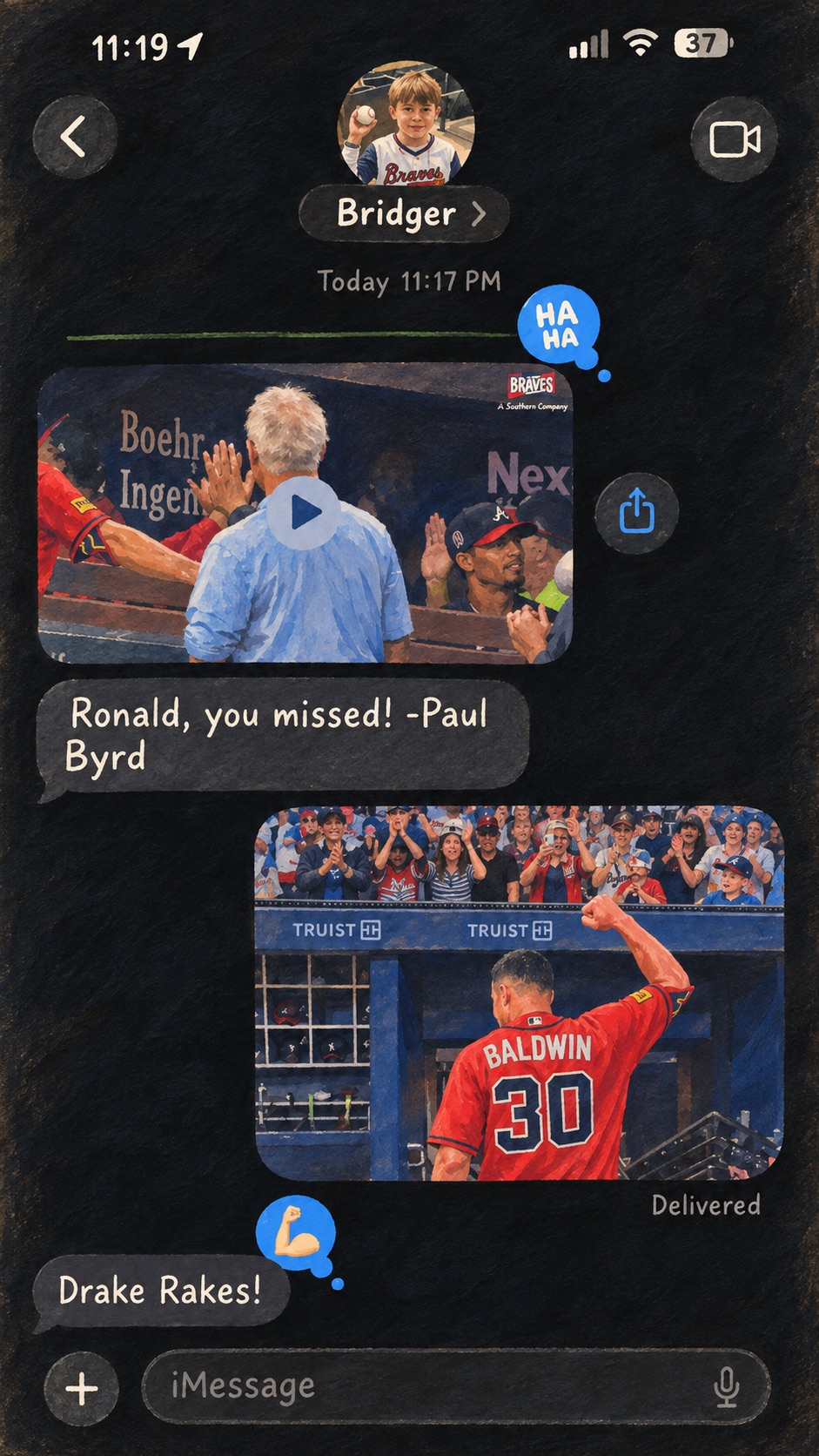
I sent Bridger a picture I took of Drake on television. The man of the hour was walking down the stairs into the dugout, BALDWIN across the back of his soaked red jersey, one fist held high above his head.
My phone buzzed at 11:18 p.m.
"Drake Rakes!" Bridger wrote.
We didn't even say goodnight. We didn't have to.
scene 17
The Crowd
The Braves' magic number was down to one.
One Braves win or one Phillies loss would give Atlanta another division championship. Staying home wasn't an option. Bridger wanted to go to the Battery and be "with the crowd."
Hudson wanted a space to run around and play.
We got in the car and drove.
There was a crowd inside Sports & Social. People were wearing red. Some were in blue.
But upon closer inspection, more than two dozen televisions were all showing football.
At first, Bridger was silent.
Then he wasn't.
"Not the Falcons!" he muttered.
It was Sunday, and football owned every screen in the building.
Suddenly Hudson asked to climb onto my back.
When a hostess arrived, I asked her if she could set us up with the Braves game in the bar area. I felt like a hooligan.
"Let me see what I can do," she said.
So there we were watching the Braves potentially clinch the division—on mute, twenty yards from the stadium, amid curses and roars as the Carolina Panthers ran up the score against a Falcons team that couldn't decide on its quarterback.
Bridger asked what a "pick six" was. I rolled my eyes and told him it wasn't good.
Hudson asked if we could go play on the plaza by the stadium.
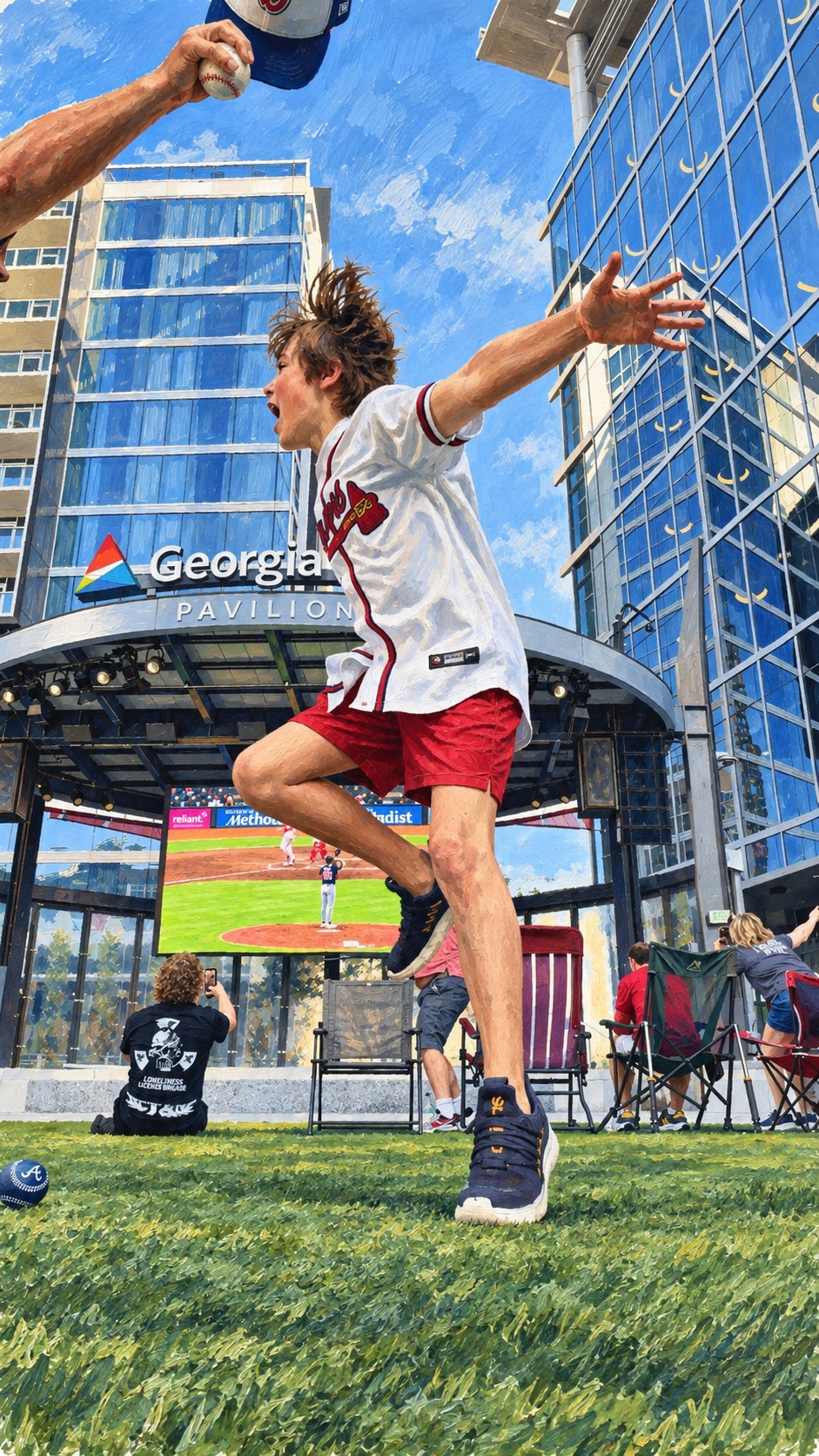
We found the Braves game playing on the large screen behind the Georgia Power Pavilion stage.
The crowd Bridger had imagined still hadn't materialized. A farmers market and petting zoo were winding down nearby. Some people watched baseball. Others bought produce.
We ignored the animals and vegetables.
The boys and I took out a soft Atlanta Braves stress ball and began rolling ground balls to each other across the artificial grass.
Behind us, Truist Park was empty. The Braves were playing hundreds of miles away in Houston. In front of us, baseball moved across a giant screen.
Eventually Bridger turned his full attention to the game.
Hudson wanted to keep playing. So did I.
I rolled another ground ball toward him. He fielded it, looked at me and smiled.
"I have the best dada."
Then he rolled the ball back.
By the ninth inning, the Braves were ahead and more people had drifted toward the screen.
One man had spent much of the afternoon cheering from a camping chair, louder than everyone else. When the final out came, he jumped up and made his way around the green, high-fiving strangers.
This was Bridger's type of fan.
Bridger had come looking for a crowd. It had mostly failed to materialize. He didn't seem to mind.
The Braves were National League East champions.
This time, it happened on his watch.
Soon it would be October. No more space for ground balls out here. No more empty seats in there.
Bridger leapt and danced across the green turf.
Soon, he would be eleven.